


Contractor Verified Renovation Checklist for Homeowners
Dylan LarocqueRequest Your Free Estimate Today
GET A FREE ESTIMATE →Before you sign anything, get three written bids on the exact same scope of work, verify the contractor carries current liability insurance and workers’ compensation coverage, and put every detail into a signed contract that names who pulls permits, when payments are due, and how change orders get handled. Skip any one of those three, and you’re negotiating blind once the walls come down.
TL;DR:
- Homeowners should require three written bids based on identical scope documents to accurately compare costs and avoid missing scope or allowances.
- Verifying insurance coverage and permits directly with providers prevents disputes and ensures project liability and warranty protections stay in place.
- A detailed, signed contract should specify project scope, timing, payment schedule, and change procedures to minimize disagreements during construction.
- Contractors must present documented pre-demo checklists and stage timelines, demonstrating effective management practices that reduce schedule delays.
- Relying on documented scope, allowances, and permit responsibilities protects homeowners more than contractor charm or verbal assurances.
Table of Contents
- What documents should you collect before hiring a contractor?
- What should you ask a contractor during the interview?
- How do you compare renovation bids without getting burned?
- What clauses does a renovation contract need?
- How do you verify insurance and permits are real?
- What should a project management checklist cover once work starts?
- What renovation mistakes cost homeowners the most?
- Contractor-verified practices behind this checklist
- What matters most when you’re the homeowner
- Ready to request a written estimate from a local contractor?
- Sources
- FAQ
What documents should you collect before hiring a contractor?
A renovation contractor checklist starts with paperwork, not personality. The contractor who shows up on time and seems easy to talk to still needs to back that up with documentation, because charm doesn’t cover a $15,000 mistake.
Before you hand over a deposit, ask for these items in writing:
- Certificate of liability insurance naming the actual contracting business (not a subcontractor or a sister company), with policy dates and coverage limits you can read and understand.
- Workers’ compensation clearance or the provincial equivalent, confirming coverage for anyone working on your property.
- Business number or GST/HST registration, along with proof of any municipal licences required for the trade.
- A portfolio of similar completed projects, ideally with photos and addresses you could drive by if you wanted to.
- Three or more references from past clients, plus a sample contract or terms you can review before you’re under pressure to sign.
The Office of Consumer Affairs recommends comparing contractors on experience with similar projects, estimated duration, permits and inspections, subcontractors, insurance, and references before you sign anything. That comparison only works if every contractor gives you the same documents to compare.
Cash deals and “under the table” pricing might look attractive on paper, but the Canada Revenue Agency warns that skipping the paper trail also strips away your warranty protection and liability coverage if something goes wrong. If a contractor pushes hard for cash and no contract, treat that as your answer, not a discount.
What should you ask a contractor during the interview?
Reference checks and interview questions separate contractors who manage a job from contractors who just show up and swing hammers. You want to know how they run a project, not just what they charge for one.
Start with the basics, then dig into project control:
- How long has the company operated under its current name, and who makes up the core crew?
- Have you completed a project similar to mine? Ask to see before/after photos and a realistic timeline for a comparable job.
- Who hires and supervises subcontractors on site, and who is my point of contact if something changes mid-project?
- How do you handle delays, and how quickly will I hear about one?
When you call references, don’t just ask “were you happy?” Ask sharper questions: did the final cost change from the original quote, and if so, why? How were change orders approved? Did the crew protect floors and furniture in occupied parts of the house? The CHBA notes that these targeted questions reveal management quality in a way that a five-star review never will.
Pro Tip: Ask every reference the same closing question: “Would you hire this contractor again for a different project?” A hesitant answer tells you more than a polished one.
How do you compare renovation bids without getting burned?
The safest way to compare renovation bids is to require three or more written estimates based on one identical scope document, not three different interpretations of “renovate the bathroom.” Hand every bidder the same list of materials, fixtures, and finishes, then compare what comes back line by line.
- Confirm the scope matches. Every bid should price the same demolition, plumbing, electrical, and finish work. If one bidder skipped an item, ask why before you compare totals.
- Line up labour and materials separately. A bid that lumps everything into one number hides where your money actually goes.
- Check allowances by name. If a quote says “standard vanity allowance,” ask for the specific model, brand, and quality tier assumed. Vague allowances are where budgets quietly blow up.
- Look for exclusions. Permits, disposal fees, and taxes should appear somewhere. If they’re missing from one bid and present in the others, that bidder is either cutting corners or hoping you won’t notice until later.
- Question the outlier. A bid that’s 30% below the others usually means missing scope, not a better deal.
A flat design or consultation fee can be reasonable for smaller jobs where the scope is simple. For anything involving structural work, plumbing relocation, or multiple trades, pay for a detailed line-item quote instead. The CRA’s own renovation guidance points to the same principle: identical scope, multiple bids, is how you catch a low-ball quote before it catches you.
What clauses does a renovation contract need?
A written contract is where every verbal promise either becomes enforceable or disappears the moment there’s a disagreement. The CHBA’s homeowner guide to renovation contracts lays out the minimum elements every agreement should contain, and skipping any of them leaves room for the kind of dispute that stalls a project for weeks.
Your contract should spell out:
- Parties and project address, including a named primary contact you can reach directly, not a general office line.
- Detailed scope and specifications, down to brand, model, and colour for major fixtures and finishes, plus a clear list of what’s excluded.
- Timing, with a start date, a substantial completion date, and a final completion date, along with what counts as an excusable delay (weather, supply shortages, permit holdups).
- Price and payment schedule, including provincial holdback rules where they apply, and the conditions that trigger final payment.
- Change-order procedure, warranty coverage, cleanup responsibilities, dispute resolution steps, and who is responsible for pulling permits.
The CHBA’s sample renovation contract goes further, separating substantial completion from full completion and requiring allowances to be documented with quantity, assumed quality, and how price differences get calculated. The more of these details you nail down in writing, the less room there is for a disagreement about who owes what to whom. Homeowners planning a bathroom project can see how detailed a scope document should look in this bathroom renovation checklist for allowances and finishes.
How do you verify insurance and permits are real?
A certificate of insurance is only as good as the details printed on it. Check that the named insured matches the actual contracting business, not a subcontractor’s name, and confirm the policy dates cover your entire project timeline, not just the start date.
If any of those details look off or vague, call the insurer or broker listed on the certificate directly. That five-minute call confirms the coverage actually applies to your project rather than to a different job entirely.
For permits, put the responsibility in writing inside the contract, then verify independently with your municipality before any concealed work begins, especially plumbing or electrical hidden behind drywall.
- Request the workers’ compensation clearance letter where your province requires one.
- Confirm the permit was actually applied for, not just discussed.
- Keep copies of permit documents and inspection reports in your own contract file, not just the contractor’s.
Pro Tip: A contractor who resists a five-minute insurer verification call is telling you something. A legitimate policy holds up to a phone call every time.
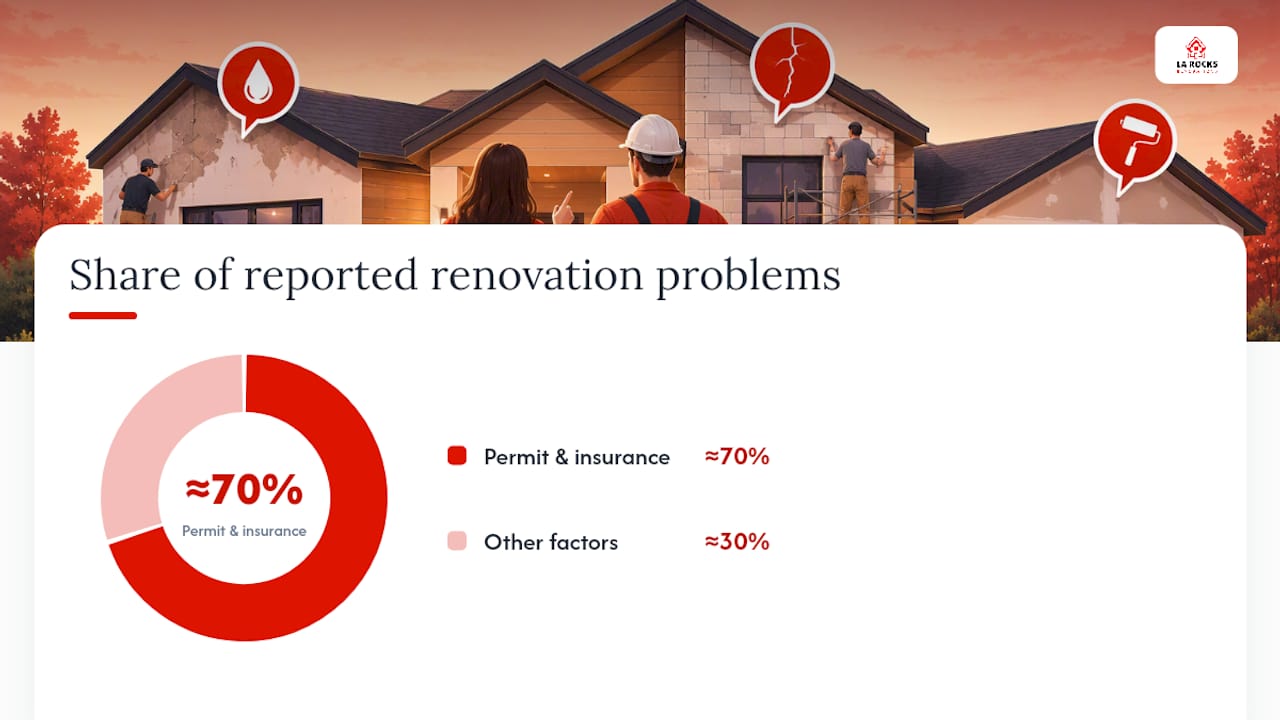
Roughly seven in ten homeowners who report renovation problems cite unclear permit or insurance responsibility as a factor, according to consumer guidance from the Office of Consumer Affairs. That single verification step prevents a disproportionate share of the disputes homeowners run into later.
What should a project management checklist cover once work starts?
Clear, early communication does more to prevent disputes than any clause buried on page four of your contract. A pre-start meeting, held before the first tool touches your house, sets the rules everyone follows for the rest of the project.
- Cover site logistics first. Agree on access to electricity and water, parking, delivery windows, material storage locations, and where the waste container sits.
- Set communication expectations. Decide how often you’ll get updates and who the single point of contact is for problems, so you’re not chasing three different people for one answer.
- Document every change in writing. A signed change order should describe the new scope and the adjusted payment terms before the work happens, not after.
- Hold back final payment strategically. Final payment should wait until a daylight walkthrough, a completed punch list, permit sign-offs, and receipt of written warranties.
The CHBA’s renovation process guide treats the pre-start meeting as one of the single most effective tools for avoiding schedule slippage, precisely because it settles the small logistical questions before they become on-site arguments. For bathroom projects specifically, this contractor-verified pre-demo checklist shows what a properly documented pre-start meeting looks like in practice.
What renovation mistakes cost homeowners the most?
Unspecified allowances cause more budget shocks than any other single item on a renovation contractor checklist. When a quote says “fixture allowance included” without naming a brand, model, or price point, you’re agreeing to a number that can move in either direction once you pick an actual tile or faucet.
- Choosing the lowest bid without confirming it covers the identical scope as the others.
- Skipping the allowance detail until after demolition starts, when leverage has already shifted to the contractor.
- Failing to plan for inspection delays, trade sequencing, or where you’ll live during a kitchen or bathroom gut.
The CHBA’s project sequence guidance outlines a typical order: planning and design, permits and approvals, demolition, rough trades, inspections, insulation and drywall, finishes, and a final punch list. Knowing that sequence in advance helps you set realistic expectations for how long each stage should actually take, which you can see mapped out in detail for a specific project type in this bathroom gut renovation timeline. For a broader look at how renovation choices affect long-term property value, this overview of renovation types and ROI offers a useful outside perspective on where your budget pays off most.
Contractor-verified practices behind this checklist
LA Rocks Renovations builds its bathroom projects around documented pre-demo checklists and stage-by-stage timelines, the same construction-stage controls covered in this guide’s project management section. Author Dylan Larocque draws on those practical checklists to shape recommendations here, grounded in what actually holds up on a job site rather than generic advice. When you interview a contractor, ask for a written pre-demo checklist and a stage timeline. If they can produce one without hesitation, that’s a good sign about how they run a project.
What matters most when you’re the homeowner
Documentation beats charm every time. A contractor who writes down scope, allowances, and permit responsibility protects you more than one who simply seems trustworthy in a living room conversation. Verify insurance yourself, ask references pointed questions, and judge contractors on how they handle change, not just how they handle a first meeting.
— Dylan Larocque
Ready to request a written estimate from a local contractor?
Choose a local, insured contractor who puts scope, allowances, and permit responsibility in writing before a single wall comes down. Find one that handles common renovation projects like bathroom renovations, basement finishing, flooring installation, and deck builds, each priced against a documented scope rather than a vague allowance.
A written estimate from LA Rocks Renovations includes the specifics this checklist recommends you demand from any contractor: materials named by brand and model, a realistic project timeline, and a pre-demo checklist for bathroom and basement work so you know exactly what happens before demolition starts. If you’re planning a bathroom renovation, a basement renovation, or a flooring project, contact LA Rocks Renovations for a project walkthrough and a written quote built on the same documented scope this guide walks you through.
Sources
- Home renovations - Office of Consumer Affairs (Government of Canada)
- Canada
- The renovation process - CHBA
FAQ
What is the most expensive part of a house to remodel?
Kitchens and bathrooms typically cost the most per square foot because they combine plumbing, electrical, waterproofing, and custom fixtures in a small space. Structural changes, like moving walls or relocating plumbing lines, add cost quickly regardless of which room you’re renovating.
What are the biggest home renovation mistakes homeowners make?
The most common mistake is accepting vague allowances for fixtures and finishes instead of requiring a named brand, model, and price point in writing. Choosing the lowest bid without confirming it covers the same scope as competing quotes is a close second, since it often means missing permits, disposal fees, or material specifications.
In what order should you do a full house renovation?
A full renovation generally follows planning and design, permits and approvals, demolition, rough trades like plumbing and electrical, inspections, insulation and drywall, finishes, and a final punch list, according to the CHBA’s renovation sequence guidance. Skipping ahead in this order, such as installing finishes before an inspection clears the rough work, usually causes rework and delays.
What does a $10,000 bathroom remodel look like?
At that budget, expect a scope that covers demolition, basic plumbing and electrical updates, waterproofing, tile, a standard vanity and toilet, ventilation, and disposal, but with modest allowances rather than premium fixtures. The Office of Consumer Affairs notes that costs vary widely by region and scope, so a credible quote at this price point should still itemize each stage rather than bundle everything into one number. LA Rocks Renovations prices bathroom projects against a documented scope rather than a flat rate, with current details available through its bathroom renovation page.