


Floating Shelves Weight Limits: What Canadian Homeowners Need to Know
Dylan LarocqueRequest Your Free Estimate Today
GET A FREE ESTIMATE →As of 2024, the working rule-of-thumb for floating shelf weight capacity is 45–50 lb per wood stud, based on manufacturer and installer guidance. Using more studs proportionally increases total capacity, and adding full-length blocking behind the drywall can further raise the load a shelf can safely support, according to Shelfology’s installation guide. The single most important rule: always anchor into wood studs or solid blocking, never into drywall alone.
-
1 stud: supports up to 45–50 lb (light to moderate load)
-
2 studs: supports up to 90–100 lb (suitable for many uses)
-
3 studs: supports up to 135–150 lb (for heavier loads)
-
Full blocking or continuous cleat: can support over 200 lb, suitable for the heaviest items when installed to code and with proper materials
Drywall anchors are limited to a low weight capacity for any load-bearing application. That is fine for a small picture frame, not for a shelf holding books or stoneware. Derate these numbers for shelves deeper than 8", older homes with compromised framing, or thin shelf material that won’t grip fasteners reliably.
Table of Contents
What determines how much a floating shelf can hold?
Four variables govern floating shelf weight capacity: the wall substrate, the number of attachment points, the bracket type, and the shelf’s own depth and material. Change any one of them and the safe load changes with it.
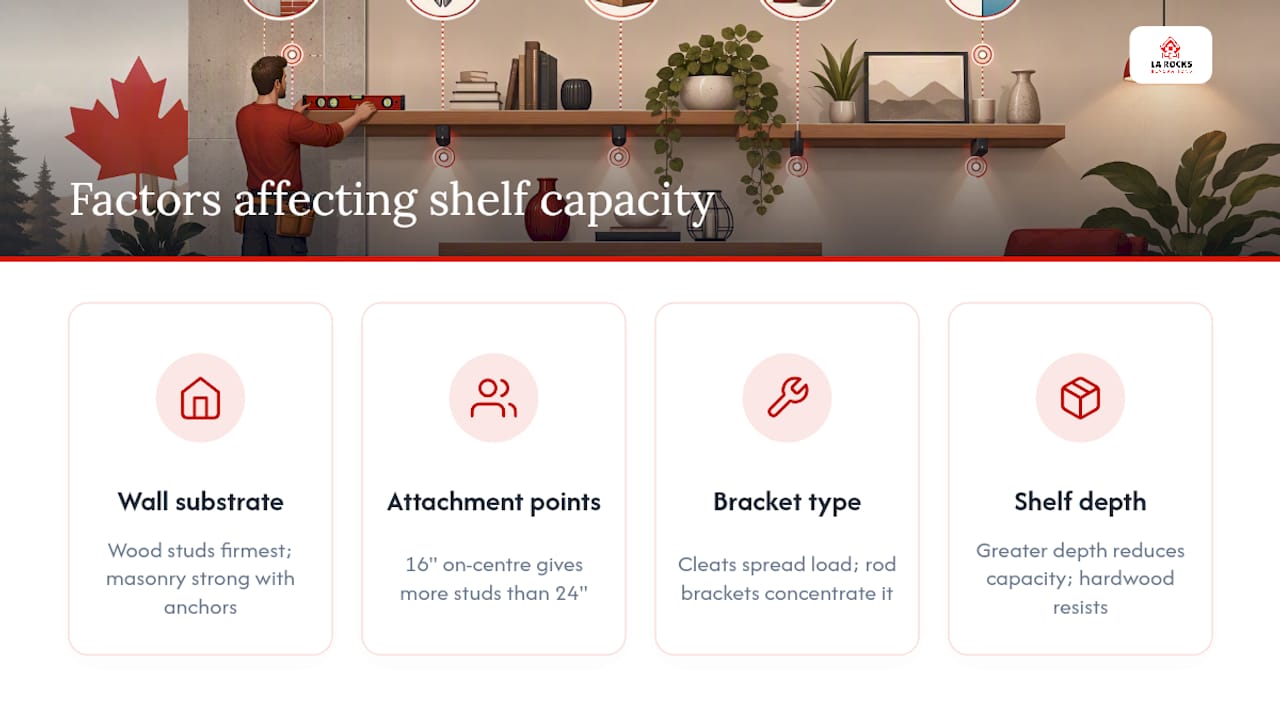
Wall substrate is the starting point. Wood studs behind drywall are the standard and give you the firmest anchor. Plaster-and-lath walls common in older Ontario homes grip screws differently and can crack around fasteners under sustained load. Masonry walls (concrete or brick) require specific masonry anchors but can actually support higher loads when done correctly. Metal studs, found in many basement renovations and commercial builds, are hollow and thin; they need toggle bolts or specialty fasteners and carry lower safe loads than wood studs of the same spacing.
Stud spacing matters because it controls how many attachment points you get across a given shelf length. Most Canadian homes built after the 1960s use 16" on-centre framing; older or some newer builds use 24" on-centre. A 36" shelf spanning 16" stud spacing can hit two studs; the same shelf on 24" spacing may only catch one. Wall type, stud spacing, and bracket design all directly affect the final safe working load.
Bracket type is where the biggest performance gap appears. Rod-style brackets (like the Aksel series) concentrate load at discrete points along the shelf. Interlocking aluminium cleat systems, such as the HOVR bracket system, spread the load continuously across the full shelf length. Continuous cleats reduce long-term sag because there is no single stress point where the shelf can begin to creep downward.
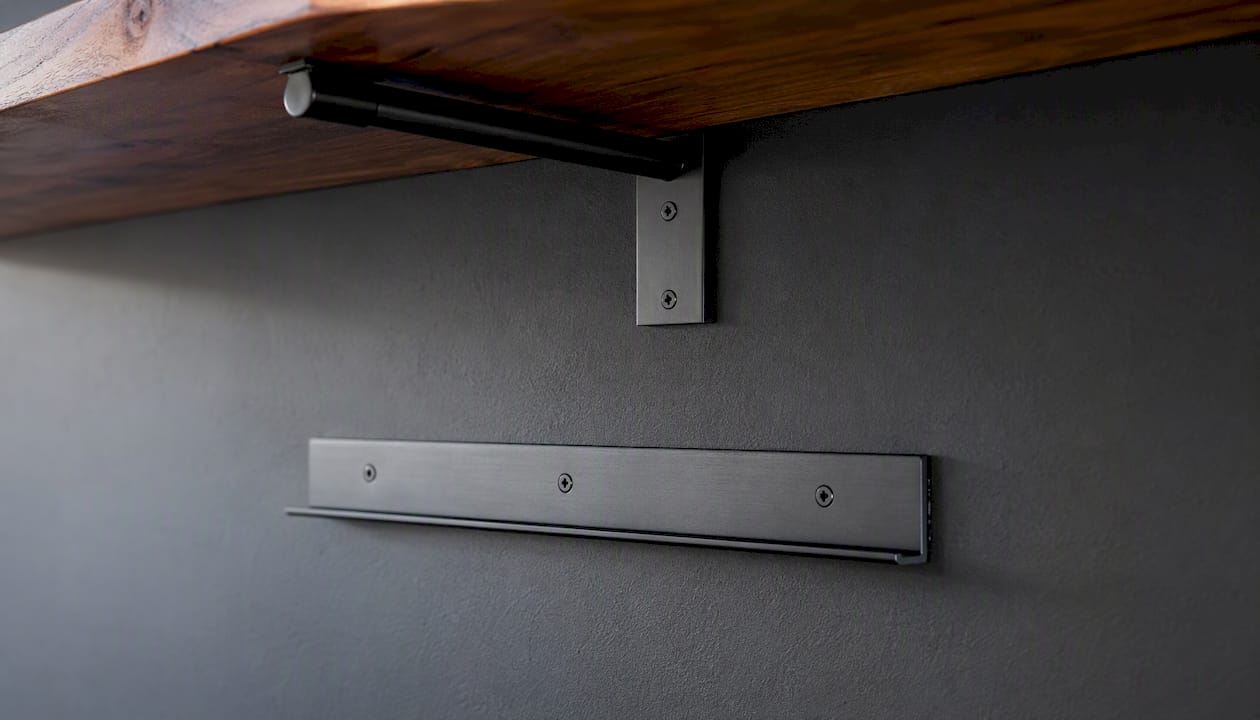
Shelf depth and material are the two most overlooked factors. A deeper shelf acts like a longer lever arm: the further the load sits from the wall, the more torque it puts on the fasteners. Rated capacities almost always assume a specific depth, so a bracket rated at 8" depth will carry less at 12". Solid hardwood resists creep and holds fasteners far better than MDF, particleboard, or hollow-core shelving, which tend to fail at the screw hole under sustained weight.
Pro Tip: Before buying brackets, write down your shelf’s planned depth and the material you intend to use. Bring those numbers to the product spec sheet — most manufacturers list their rated capacity at a specific depth and minimum thickness.
Typical capacity numbers and real-world bracket examples
The table below shows common configurations and their qualitative safe working loads. These figures assume correct installation into wood studs with appropriate fasteners.
| Configuration | Approx. capacity | Notes |
|---|---|---|
| 1 wood stud, rod bracket | 45–50 lb | Suitable for light décor |
| 2 wood studs, rod bracket | 90–100 lb | Suitable for books or moderate kitchen items |
| 3 wood studs, rod bracket | 135–150 lb | Suitable for heavier collections |
| Full blocking + continuous cleat | 200+ lb | Requires framing work for best support |
| HOVR-class cleat, 8" depth | 300 lb (with 1.75" shelf) | Rated for thick shelves; proper install required |
The HOVR bracket system is the benchmark for heavy-duty floating shelves. Shop tests show an average capacity of 300 lb at 8" shelf depth when mounted into studs with a minimum 1.75" thick shelf. Drop to a 1.5" thick shelf and that rating falls to roughly 150 lb — a reminder that the shelf material is part of the system, not just the bracket.
The Aksel XD brackets from Shelfology have rated capacities per rod at moderate to high weights. The Aksel HD line supports shelves within typical thickness and depth ranges with solid per-rod capacity. Adding rods increases total capacity, though real-world conditions require applying safety margins.
-
“Heavy-duty” on a product label is a marketing claim, not an engineering specification. Look for explicit figures: capacity per stud, tested depth, and minimum shelf thickness.
-
Manufacturer ratings reflect controlled shop conditions. Your wall substrate, stud quality, and shelf material may differ.
-
A reseller summary of HOVR-class systems confirms the 300 lb average load capacity at 8" depth and stresses that correct installation into studs is non-negotiable for achieving that rating.
Installation best practices: tools, fasteners, and special cases
A solid install starts before the first screw goes in.
Special cases to know:
- Very long or deep shelves: Spans over 48" benefit from a continuous cleat rather than discrete brackets. Avoiding common installation mistakes — like skipping pilot holes or relying on a single central bracket — prevents the most frequent failures.
How to spot shelf failure before it becomes a problem
Most floating shelf failures give warning signs well before anything falls.
Common failure modes:
-
Shelf sag (creep): The shelf bows downward over time, usually at mid-span. Rod-style brackets are more prone to this than continuous cleats because load concentrates at discrete points.
-
Screw pullout: The fastener works loose from the stud, often because the screw was too short or the pilot hole was too large.
-
Split shelf material: MDF and particleboard crack around the rod holes under sustained load, especially when the shelf is near its rated capacity.
-
Wall cracking: Hairline cracks radiating from the bracket mounting points signal that the fasteners are pulling through the substrate.
Inspection checklist — run this every six months on loaded shelves:
-
Sight down the shelf from one end. Any visible bow greater than ¼" over a 36" span warrants action.
-
Check each screw head. If any have backed out even slightly, tighten and inspect the stud behind the wall.
-
Press lightly on the shelf near each bracket. Movement or a hollow sound suggests the fastener is no longer fully engaged.
-
Look at the wall surface around each bracket plate for paint cracking or bubbling.
A shelf carrying more than 50 lb that shows any sag or loose fasteners should be unloaded immediately. Redistribute items, add a bracket, or call a professional before reloading.
Quick fixes: Redistribute the load toward the wall end of the shelf. Add a second bracket if the span allows. For screw pullout, fill the hole with a hardwood dowel and wood glue, let it cure fully, then re-drive the screw.
When should you call a professional?
Some shelf installs are straightforward DIY. Others carry enough structural risk that a professional is the right call.
Hire a contractor when:
-
The shelf span exceeds 36" and will carry books, stoneware, or small appliances.
-
You cannot locate studs, or the studs feel soft or damaged when probed.
-
The wall is metal-stud framing (common in finished basements).
-
You want a continuous cleat system that requires opening the wall to install blocking.
-
The shelf is in a bathroom or kitchen where moisture may affect the wall substrate over time.
-
You are unsure whether your older home’s framing can handle the planned load.
A professional installer will conduct a structural audit of the wall, install blocking or backing where needed, select and fit engineered bracketing, and confirm the safe working load before handing the job back to you. For custom carpentry and shelving work in Durham Region, that process typically includes a site visit, a framing assessment, and a documented installation.
Key takeaways
The safest floating shelf is one anchored into studs or solid blocking, sized to a bracket with explicit engineering data, and loaded to no more than half its nominal capacity.
| Point | Details |
|---|---|
| Per-stud rule-of-thumb | Use 45–50 lb per wood stud; two studs support roughly 90–100 lb. |
| Drywall anchors are not enough | Drywall anchors max out at roughly 20 lb — never use them for load-bearing shelves. |
| Depth reduces capacity | Rated capacities assume a specific depth; derate by 10–15% per 2" beyond the spec. |
| Apply a safety factor | Multiply nominal capacity by 0.5–0.67 for a realistic safe working load. |
| LA Rocks Renovations | For heavy loads or complex walls in Durham Region, LA Rocks Renovations provides framing, blocking, and tested custom shelf installations. |
What contractors see that most DIYers miss
The most common issue on site is not a bad bracket choice — it is a homeowner who planned the shelf around the room’s aesthetics and only thought about load after the fact. A shelf positioned between two studs because it “looked centred” on the wall, then loaded with a full set of encyclopaedias, is a failure waiting to happen.
Old plaster walls deserve particular caution. The lath behind the plaster is often inconsistent, and screws that feel solid during installation can work loose within months as the plaster shifts seasonally. The professional fix is to cut a channel, install a solid wood cleat spanning two or more studs, patch the plaster, and mount the bracket into the cleat. It takes longer, but the shelf will outlast the house.
Thin shelving material is the other repeat offender. A homeowner buys a beautiful 3/4" MDF shelf, installs a quality bracket, loads it with cast iron, and wonders why the rods are pulling through the shelf face within a year. Solid hardwood at 1.5"–1.75" thickness is not just an aesthetic upgrade — it is a structural one. The fastener has real material to grip, and the shelf resists the bending forces that MDF simply cannot sustain over time.
The weakest component in the system sets the ceiling for everything else. A 300 lb bracket mounted into a crumbling plaster wall with 1½" screws is a 20 lb shelf. Spend the time on the substrate and the material first; the bracket is the last decision, not the first.
LA Rocks Renovations handles the heavy lifting
When the load is heavy, the wall is complicated, or you simply want the job done right the first time, LA Rocks Renovations is the practical alternative to a DIY install that carries real risk.
LA Rocks Renovations serves Bowmanville, Clarington, and communities across Durham Region, offering framing, blocking, drywall work, and custom carpentry as part of a complete shelving installation. The team assesses your wall structure, installs backing where needed, fits the right bracket system for your load, and confirms the safe working load before the job is complete. No guesswork, no callbacks.
If you are planning a shelf for a bathroom, kitchen, or finished basement in Durham Region, contact LA Rocks Renovations for a site visit and quote. Bring your shelf dimensions and a rough idea of what you plan to store — the team will handle the rest.