


Profile First: 3 Steps to Choose Deck Railing Without Costly Rebuilds
Dylan LarocqueRequest Your Free Estimate Today
GET A FREE ESTIMATE →Pick your rail profile and infill before you pick a material. Aluminum or cable railing suits homeowners who want an unobstructed view and almost no upkeep, composite panel systems give a wood look without the sanding and staining, and pressure-treated wood still fits a classic cottage build on a tighter budget. Whatever you choose, confirm guard height and baluster spacing with your local building department before you order materials.
TL;DR:
- Prefabricated square baluster panels in aluminum or steel cut installation time and labor costs compared to traditional piece-built balusters.
- Modern railings with slim profiles and matte black finishes are trending, often paired with glass or cable infill for unobstructed views.
- Aluminum and vinyl railings offer the lowest maintenance and longest lifespan, exceeding 20 years for many products, while wood needs regular sealing or staining.
- Structural post selection and spacing must match the infill’s weight and wind load demands, especially for glass or privacy panels requiring tighter anchoring.
- Incorporating accessories like lighting or custom signage requires early planning, as retrofitting these features is usually more expensive after installation.
Table of Contents
- Deck railing options: matching style families to your home
- Best deck railing materials: aluminum, wood, composite, vinyl, steel, glass, and cable compared
- Posts, structural upgrades, and railing accessories worth specifying
- What deck railing maintenance, lifespan, and costs actually look like
- Safety and building code basics before you finalize a design
- Deck railing trends, privacy ideas, and budget-friendly designs
- What to ask an installer before signing a deck railing contract
- Customizing your railing with colour, shape, and detail
- Environmental impact and sustainability across railing materials
- Retrofitting a new railing onto an existing deck
- Author perspective: profile first, then material, always
- How LA Rocks Renovations builds and installs deck railing across Durham Region
- Sources
- FAQ
Deck railing options: matching style families to your home
Every deck railing option falls into one of three visual families, and picking the family first will save you from a mismatched, expensive redo later. Trade guides now group railing systems by profile rather than by material, because the shape of the top and bottom rail sets the whole look before you even choose what fills the space between the posts.
Modern railings use squared, slim top and bottom rails, often around 2.25 inches, paired with clean vertical lines or unobstructed glass and cable. This is the family homeowners reach for when they want the deck to disappear into the backyard view rather than compete with it. Modern profiles pair naturally with aluminum, steel, or cable, and they tend to look sparse or thin if you try to force them into a heavy wood build.
Designer lines use larger, more decorative rail sections and open up far more infill choices, from mixed metal baluster patterns to composite panels with routed details. If you want a railing that reads as a feature rather than a formality, this family gives you the most room to play with colour, texture, and pattern without looking custom-built from scratch.
Traditional railings keep the classic square baluster look most people picture when they hear “deck railing.” Wood and vinyl dominate this family because both materials handle turned or routed details well, and the look ages naturally with a cottage or a century-home exterior.
Once you know your family, the infill choice narrows fast:
- Vertical balusters (wood, aluminum, vinyl, or steel) give the traditional look, block almost nothing visually, and are the easiest infill to repair one piece at a time.
- Square panels are prefabricated, install in one piece, and pair well with aluminum or steel systems to cut labour time significantly.
- Glass panels preserve sightlines almost completely and suit modern builds, but every fingerprint and rain streak shows.
- Cable railing gives the clearest view of any infill type, since horizontal wires barely register to the eye, but the system depends on rigid end posts and precise tensioning to stay taut over time.
- Lattice infill offers partial privacy and a cottage feel at a low cost, though it blocks less wind than a solid panel and less view than an open baluster.
Your style choice also decides how much flexibility you’ll have with finishes down the line. A modern aluminum profile takes a factory powder coat that lasts for years without touch ups, while a traditional wood baluster system will always need periodic staining or painting regardless of how well it’s built. Choosing the profile first means you’re choosing your long-term maintenance commitment at the same time, whether you realize it or not.
Best deck railing materials: aluminum, wood, composite, vinyl, steel, glass, and cable compared
Once you’ve settled on a style family, the material decision comes down to five practical factors: how much upkeep you’re willing to do, how the material handles your climate, what finish options exist, how complicated installation gets, and what it costs to buy and install. Here’s how the common deck railing materials stack up against each other.
Aluminum is the low-maintenance workhorse of the group. Powder-coated aluminum resists corrosion well and is widely specified for coastal and wet-climate decks because it doesn’t rust, rot, or need refinishing. It comes in modern square profiles and traditional baluster patterns, so it works across style families, and prefab panel sections keep installation relatively straightforward for a contractor crew.
Composite railing mimics wood grain and colour without the sealing schedule. It resists moisture and insects completely, holds its colour longer than most stained wood, and works well in humid or freeze-thaw climates. The trade-off is a higher upfront material cost than basic wood, and some composite profiles feel slightly “plasticky” up close compared to real grain.
Wood remains the most affordable entry point and the easiest material for a handy homeowner to repair piece by piece. Pressure-treated pine, cedar, and fir all work, but every wood railing needs sealing or staining on a recurring schedule to prevent splitting, greying, and rot. It’s the traditional-family default, and it’s genuinely the best fit if your goal is matching an existing wood deck or fence on a tight budget.
Vinyl is essentially maintenance-free once installed. It never needs painting, resists moisture completely, and cleans up with soap and water. It suits traditional baluster styles particularly well, though colour options are more limited than composite, and vinyl can look slightly less premium than aluminum or composite in a modern build.
Steel brings an industrial, heavier-gauge look that aluminum can’t replicate. It’s stronger per square inch than aluminum, which matters for large glass or privacy panel spans, but steel needs a durable coating and periodic touch-ups anywhere the finish gets scratched, or surface rust will start.
Glass gives the most unobstructed view of any material, full stop. Frameless or semi-framed glass panels suit modern builds and any deck where the view is the whole point of building a deck in the first place. The trade-off is cleaning frequency, since glass shows every water spot, and mounting hardware needs to be installed correctly the first time, because glass panels aren’t a forgiving material to adjust after the fact.
Cable railing is the material most homeowners underestimate on installation complexity. It delivers the clearest sightline of any infill option, but cable systems demand rigid posts and precise tensioning across the whole run, or the wires sag and lose their clean look within a season or two. If your existing deck framing or posts are marginal, cable is not the material to attempt as a first DIY project.
Statistic Callout: Prefabricated square baluster panels install in a single piece and pair naturally with aluminum or steel systems, cutting on-site cutting and labour time compared to piece-built traditional balusters.
Where installation complexity should push you toward professional help: cable tensioning, glass panel mounting, and any structural post upgrade needed to carry privacy panels or heavier infill. A contractor with deck-specific experience will catch post spacing and anchoring issues before they become a failed inspection.
Posts, structural upgrades, and railing accessories worth specifying
The posts holding your railing up matter as much as the infill you choose, and this is the part homeowners most often overlook when they’re shopping by looks alone. Post size, spacing, and anchoring all shift depending on what infill you’re carrying: solid privacy panels and glass panels act like sails in the wind, and cable systems put continuous tension load on every end post in the run.
Here’s what to work through with your installer before finalizing a design:
- Confirm post spacing matches your infill’s structural demands. Cable runs and heavy glass panels typically need tighter post spacing and larger post dimensions than an open baluster system.
- Decide between sleeved and structural posts. Sleeved posts wrap a decorative shell around a structural core, which lets you upgrade the look later without touching the frame. A fully structural post is simpler to build but harder to refinish or replace individually down the road.
- Choose your accessories before the framing goes in, not after. Integrated post-cap lighting, drink rail caps, and continuous ADA-style handrails all need to be planned into the post layout from the start, since retrofitting them onto a finished railing usually means redoing hardware or drilling into a finished surface.
Pro Tip: If you’re adding integrated lighting or a drink rail cap, ask your contractor to run wiring or plan the cap width before the posts are set, not after. Retrofitting either one onto finished railing almost always costs more than building it in from day one.
What deck railing maintenance, lifespan, and costs actually look like
Maintenance schedules vary more by material than most homeowners expect going in. Wood needs sealing or staining roughly every one to two years depending on sun exposure, or it starts greying and splitting at the surface. Composite needs only periodic cleaning with soap and water since it doesn’t absorb moisture the way wood does. Cable systems need an annual tension check, since wires stretch slightly over time and can start to sag. Vinyl and aluminum need the least attention of any material, usually just a rinse a few times a year.
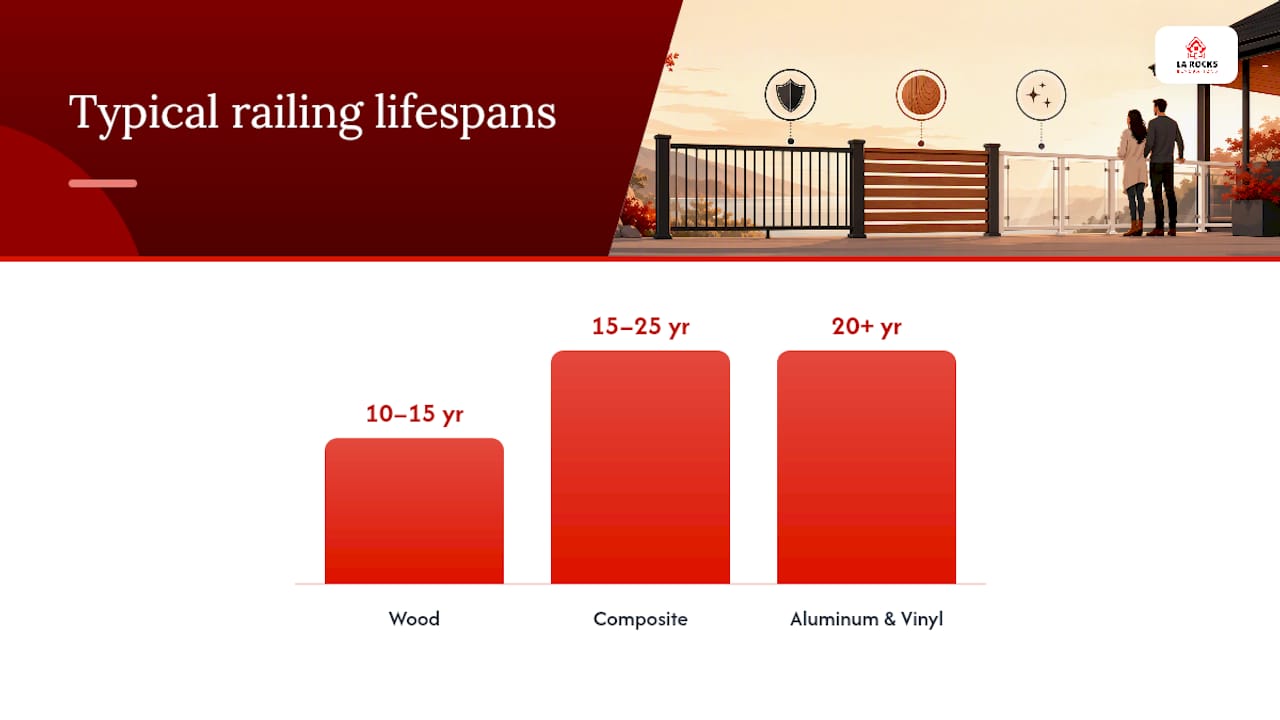
Lifespan follows the same pattern. Quality aluminum and vinyl railings commonly last 20 years or more with minimal intervention. Composite typically holds up 15 to 25 years depending on the product line. Wood railings, even well-maintained ones, tend to need baluster or rail replacement somewhere in the 10 to 15 year range as individual pieces weather unevenly.
Cost is where privacy and view-focused choices diverge the most:
- Standard open baluster systems in wood, vinyl, or aluminum sit at the lower end of most renovation budgets.
- Cable and glass systems cost more per linear foot due to hardware and precise fabrication tolerances.
- Privacy railing sections commonly run $40 to $100 or more per linear foot, with frosted glass landing at the higher end of that range because of the stronger posts and extra materials privacy panels require.
- Prefab panel kits tend to cost less in labour than fully custom-built railings, even when the material itself costs slightly more per foot.
Statistic Callout: Privacy panels increase lateral wind load on posts significantly compared to open infill, which is why privacy sections generally cost more to build correctly than a standard open baluster run of the same length.
Safety and building code basics before you finalize a design
Every deck railing option has to clear the same baseline safety requirements no matter how it looks. Residential guard height is typically 36 inches for a deck railing, while stair handrails are commonly required somewhere between 34 and 38 inches depending on your local code. These figures shift by jurisdiction, so treat them as a starting point, not a final answer, for your specific municipality.
Baluster spacing follows what’s often called the four-inch or “ball rule”: a solid four-inch sphere should not be able to pass through any gap in the railing, which keeps small children from slipping through. This spacing requirement applies to vertical balusters, cable runs, and most infill types, though the exact test method can vary by local building department.
A few other code basics worth confirming before you order materials:
- Privacy panels and solid infill change the structural math because they catch wind load the way an open baluster never will, which usually means stronger posts and tighter anchoring to the deck frame.
- Continuous handrails on stairs often need to meet separate grip and height rules from the main deck guard.
- Local building departments sometimes require a permit even for a railing-only replacement, especially if post footings or framing are being altered.
For homeowners in Ontario specifically, LA Rocks Renovations has a full breakdown of deck railing height and code requirements worth reading before you commit to a design, and a companion guide covers stair railing code if your deck includes steps.
Deck railing trends, privacy ideas, and budget-friendly designs
The clearest trend in deck railing right now is the shift toward slim, squared modern profiles, often around 2.25 inches, paired with matte black or textured black finishes instead of the glossy white or brushed aluminum look that dominated for years. Mixed-material builds are also gaining ground: a wood top rail over aluminum balusters, or a composite deck with a cable or glass railing to keep the view open.
For homeowners chasing privacy without losing all the light, a few approaches work well:
- Partial screening with taller panels on one side only, usually facing a neighbour’s window or a busy street, while keeping the rest of the railing open.
- Louvered slats, angled to block a direct sightline while still letting air and some light through.
- Frosted or etched glass panels, which keep the modern look while obscuring the direct view through the panel.
- Planter integration, where built-in planter boxes along the rail line do double duty as a natural screen that grows in over a season.
If budget is the deciding factor, standard open baluster systems in wood or vinyl remain the most affordable route, and lattice infill gives partial privacy at a fraction of the cost of solid panels or frosted glass. Whatever you choose, keep the wind-loading and post-anchoring requirements in mind. Any solid or near-solid screening approach needs the same structural review a full privacy panel would, even if it looks like a lighter-duty addition.
What to ask an installer before signing a deck railing contract
Bring a three-step checklist to every quote conversation: confirm the style and profile first, then the post specifications, then the material and accessories. This order keeps quotes comparable across contractors and stops the conversation from jumping straight to price before the design is actually settled.
Ask your installer to walk through these site-specific issues before you sign anything:
- Framing condition. Weak or undersized joists at the deck perimeter can turn a straightforward railing swap into a framing repair job, especially with cable or glass systems that demand rigid support.
- Post levelness and spacing. Uneven existing posts on an older deck often need to be reset or replaced rather than simply having new railing bolted on top.
- Hidden utilities. Buried wiring for deck lighting or nearby electrical runs can complicate post anchoring if they weren’t mapped before the original build.
Some contractors build and service decks across Durham Region, often starting quotes with a three-step review before discussing materials.
Customizing your railing with colour, shape, and detail
Colour and finish choices have moved well past the old standard of white vinyl or bare wood. Powder-coated aluminum and steel now come in a wide range of factory finishes, with matte black and bronze tones leading current demand, and both hold their colour far longer than a painted wood surface exposed to the same sun.
Shape gives you another layer of personalization. Square, slim modern profiles read as minimal and architectural, while turned or routed traditional balusters bring a decorative, almost furniture-like detail to the same basic function. Post caps are an easy, low-cost way to add a decorative touch without committing to a full custom design: solar caps, decorative finials, and even custom nameplates are common upgrades homeowners add after the main build is finished. If you’re considering a nameplate or house sign integrated into a post or gate area, a custom sign specialist can help you avoid the finish failures that come with DIY exterior signage, since exterior-grade coatings behave differently than indoor finishes.
Mixed materials are also a personalization tool in their own right. Pairing a wood cap rail with metal balusters, or running a glass panel section next to a solid privacy screen, lets you tailor privacy and views by zone rather than committing one material to the whole railing run.
Environmental impact and sustainability across railing materials
Material choice affects your deck’s environmental footprint well beyond the build itself. Wood is a renewable resource when sourced responsibly, but pressure-treated lumber uses chemical preservatives, and shorter lifespans mean more frequent replacement and disposal over the life of the deck.
Aluminum and steel both carry high recycled content in most manufacturing lines, and both materials are fully recyclable at the end of their service life rather than heading to a landfill. Composite railing typically blends recycled wood fibre and recycled plastic, diverting material that would otherwise be waste, though composite itself is harder to recycle again once it reaches the end of its own lifespan.
Vinyl is durable and low-maintenance, but it’s petroleum-based and not widely recyclable in most municipal programs. Glass is fully recyclable in theory, though the tempered safety glass used in railings often isn’t accepted by standard glass recycling streams.
The longest-lasting material in any given climate is usually the more sustainable overall choice, since fewer replacement cycles mean less material consumption over the deck’s lifetime, even when the initial manufacturing footprint is higher.
Retrofitting a new railing onto an existing deck
Swapping railing on a deck you already own comes with its own set of checks that a brand-new build doesn’t. Start with the framing at the deck perimeter, since older decks were sometimes built to lighter structural standards than current code requires, particularly if you’re upgrading from an open baluster system to something heavier like glass or a full privacy panel.
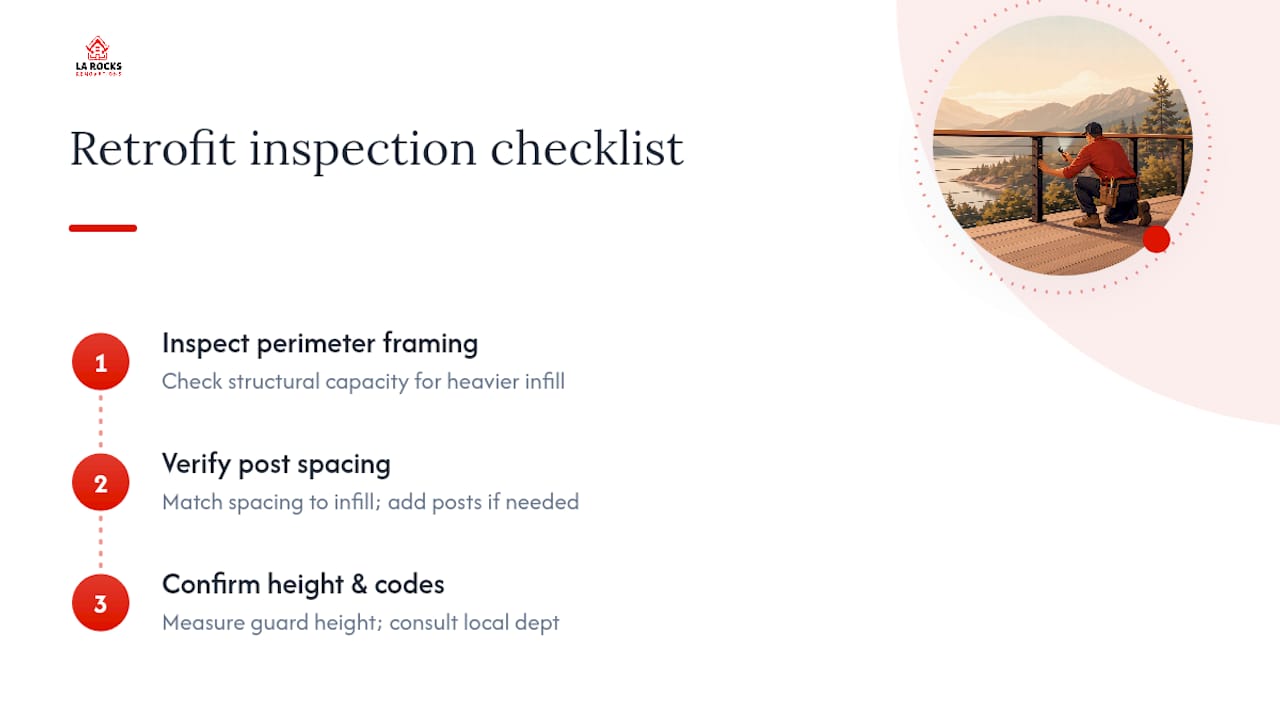
Post spacing on an existing deck may not match what your new infill needs. Cable railing and large glass panels both want tighter, more consistent post spacing than a traditional baluster run, which sometimes means adding posts rather than simply reusing what’s there. Sleeved post systems are particularly useful for a retrofit, since they let you upgrade the visual profile without tearing into the structural post underneath.
Older decking material and railing height should also be checked together. Many decks built years ago sit below the guard heights required by current code, so a retrofit is often the moment to correct a height that was technically grandfathered in but no longer meets today’s standard. It’s worth confirming with your local building department whether a railing-only replacement triggers a full code review or just an inspection of the new work.
Author perspective: profile first, then material, always
Homeowners spend most of their research time comparing materials when the profile and infill decision should come first. Pick the visual family, whether modern, designer, or traditional, and the material list narrows itself almost automatically. Posts and accessories come last, once the structural math is settled around whatever infill you’ve chosen.
That order avoids the most common expensive mistake: falling for a cable or glass look on Pinterest, then discovering the existing posts can’t support it without a rebuild. This sequence is commonly used by deck contractors in Durham Region during the quoting process.
— Dylan Larocque
How LA Rocks Renovations builds and installs deck railing across Durham Region
Deck railing design and installation is typically handled as part of full deck construction in various service areas, allowing railing profile, posts, and material to be planned together rather than added as an afterthought. That matters most on retrofits, where an existing deck’s framing has to be checked before anyone commits to cable, glass, or a heavy privacy panel.

A site visit starts with the same three-step approach covered above: style and profile, then post specifications, then material and accessories. You’ll get a clear picture of what your existing structure can support before any pricing gets discussed, which keeps the final quote honest instead of full of change orders later. If your deck needs new railing, a full rebuild, or anything in between, get a quote through the deck construction and railing page and a member of the team will walk the site with you before recommending a design.
Sources
- How to Choose a Deck Railing System: Materials, Styles and Selection Steps
- Types of deck railings and styles you should consider
- Privacy Deck Railing: Ideas, Materials & Build Tips
FAQ
What is the cheapest way to do deck railing?
Standard open baluster railing in pressure-treated wood or vinyl is the most affordable route, since it avoids the stronger posts and extra materials privacy panels or glass require. Lattice infill is a low-cost way to add partial privacy without the full cost of solid panels or frosted glass.
What can I use instead of a deck railing?
A guard rail is required by code on any deck above a certain height, so there’s no true substitute where code applies. Where a lower deck or ground-level platform doesn’t require a guard, some homeowners use dense planting, a low garden wall, or a change in grade to visually mark the edge instead.
What are the current deck railing trends?
Slim, squared modern profiles around 2.25 inches are leading current designs, often finished in matte or textured black rather than the traditional white or bare aluminum look. Mixed-material builds, glass panels, and cable infill are all gaining ground with homeowners who want to keep the view as open as possible.
What is the 4 ball rule for railing?
The rule states that a solid four-inch sphere should not be able to pass through any gap in a deck railing, which is the baseline test many codes use for baluster and infill spacing. It’s designed to keep young children from slipping through the railing, and it applies to vertical balusters, cable runs, and most other infill types, though local building departments may apply their own exact test method.
What does LA Rocks Renovations charge for deck railing installation?
Pricing depends on the style, material, and structural work each deck needs, so current rates are available directly through the deck construction and railing page. A site visit and quote will confirm exact costs once the profile, posts, and material are settled.