


50 CFM Rule: Bowmanville Bathroom Fans, Code & Contractor Checks
Request Your Free Estimate Today
GET A FREE ESTIMATE →Ontario Building Code 9.32 requires bathroom fans to move roughly 25 litres per second (about 50 CFM) on an intermittent switch or about 10 litres per second (20 CFM) continuously through an HRV, and the single rule that matters most is duct termination: it must vent to the outdoors, never into an attic or soffit. If your bathroom needs new ducting, a new circuit, or a condo stack tie-in, bring in a licensed contractor before you buy a fan.
TL;DR:
- Proper duct termination outdoors with a functioning backdraft damper is mandatory and the most common code violation, especially venting into attics or soffits.
- Bathroom fans should be sized at 1 CFM per square foot, with higher airflow needed for larger or heavily used bathrooms, and noise levels should stay at 1.5 sones or less for frequent use.
- Duct routing significantly impacts fan performance, with flexible ducts and multiple bends reducing airflow by up to 40 percent, making rigid metal ducts preferable.
- Costs vary from simple like-for-like swaps to full retrofits involving duct and wiring upgrades, with condo tie-ins often requiring management approval and additional permits.
- Regular cleaning and inspection are crucial, and fans should be replaced if airflow weakens, noise increases, or duct issues into the attic or mold problems are detected.
Table of Contents
- Bathroom ventilation exhaust fans: what Bowmanville homeowners need to know about code
- How do I choose the right bathroom exhaust fan?
- Why does duct routing matter more than the fan itself?
- What does it cost to install or upgrade a bathroom fan?
- How do I maintain a bathroom fan and know when to replace it?
- What does a licensed contractor check on-site?
- Do Bowmanville and Durham Region have specific permit rules?
- What fan brands hold up well in Canadian bathrooms?
- What electrical requirements apply to a new fan?
- How does fan choice affect mould risk in Ontario’s climate?
- A contractor’s take on fixing ventilation early
- Get a proper ventilation assessment before you renovate
- Where to confirm code and product details
- Sources
- FAQ
Bathroom ventilation exhaust fans: what Bowmanville homeowners need to know about code
Ontario gives homeowners two legal paths to bathroom ventilation, and most Bowmanville homes use the first one. A switched exhaust fan needs to move about 25 L/s, or roughly 50 CFM, whenever it’s turned on. The second path relies on continuous ventilation through a heat recovery ventilator or energy recovery ventilator, which only needs to deliver about 10 L/s, or 20 CFM, because it runs around the clock rather than in short bursts.
Either way, the duct has to terminate outdoors, fitted with a backdraft damper that stops cold air and pests from working their way back in. Terminating into an attic or soffit is not a grey area. It’s a direct code violation, and it’s also the single most common mistake found in older Durham Region homes.
Permitting depends on scope:
- Like-for-like fan swap (same location, same duct run): usually no permit required.
- New ducting, a new electrical circuit, or a bathroom addition: typically requires a permit.
- Condo stack tie-ins: often need building management or condo corporation approval on top of any municipal permit.
Confirm specifics with the Clarington or Durham Region building department before work starts. CMHC’s renovation guidance also recommends professional consultation any time ventilation changes are part of a larger renovation.
How do I choose the right bathroom exhaust fan?
Sizing starts with a simple baseline: 1 CFM per square foot of bathroom floor area.
From there, the recommended bands widen depending on how the room is used.
| Bathroom size | Recommended CFM |
|---|---|
| Under 50 sq ft | 50 CFM |
| 50 sq ft | 70 to 80 CFM |
| — | 90 to 110 CFM |
| — | 1 CFM per sq ft, plus 50 CFM per fixture |
Airflow numbers only matter if the fan actually gets used, and that’s where sones come in. A sone rating measures perceived loudness, and industry guidance from the Home Ventilating Institute recommends 1 sone or less for bathrooms used frequently, with 1.5 sones as a reasonable upper limit elsewhere. A fan rated at 4 or 5 sones sounds like a small vacuum, and homeowners routinely leave those switched off, which defeats the entire purpose of installing one.
Feature choice comes down to habits. A humidity sensor turns the fan on automatically once moisture rises past a set threshold, which solves the classic problem of someone forgetting to flip the switch. A basic timer costs less and still beats a manual switch, since it guarantees the fan runs long enough after a shower to clear the air. Combination light and heat units add comfort on cold mornings but cost more up front and complicate wiring.
Pro Tip: If you’re outfitting an ensuite that gets heavy daily use, spend the extra money on a humidity sensor rather than a bigger motor. A correctly sized fan that runs automatically beats an oversized fan that never gets switched on.
Why does duct routing matter more than the fan itself?
You can buy the best-rated fan on the market and still end up with a damp, mouldy bathroom if the ductwork behind it is wrong. Long runs of flexible duct, or ducts with several 90-degree turns, can cut delivered airflow by 20 to 40 percent or more compared to the fan’s rated CFM. A fan stamped 80 CFM on the box might only be pushing 50 CFM out the wall by the time the air fights its way through a crushed, kinked duct run.
Rigid metal duct outperforms flexible duct almost every time, especially over longer distances, and minimizing the number of bends matters as much as the material choice. Two acceptable termination points exist:
- Roof cap with a functioning backdraft damper.
- Wall cap with a functioning backdraft damper, mounted where it won’t blow directly onto a walkway or neighbouring window.
Terminating into a soffit or open attic space is not an acceptable substitute for either option, no matter how common it still is in Durham Region homes built before current code cycles.
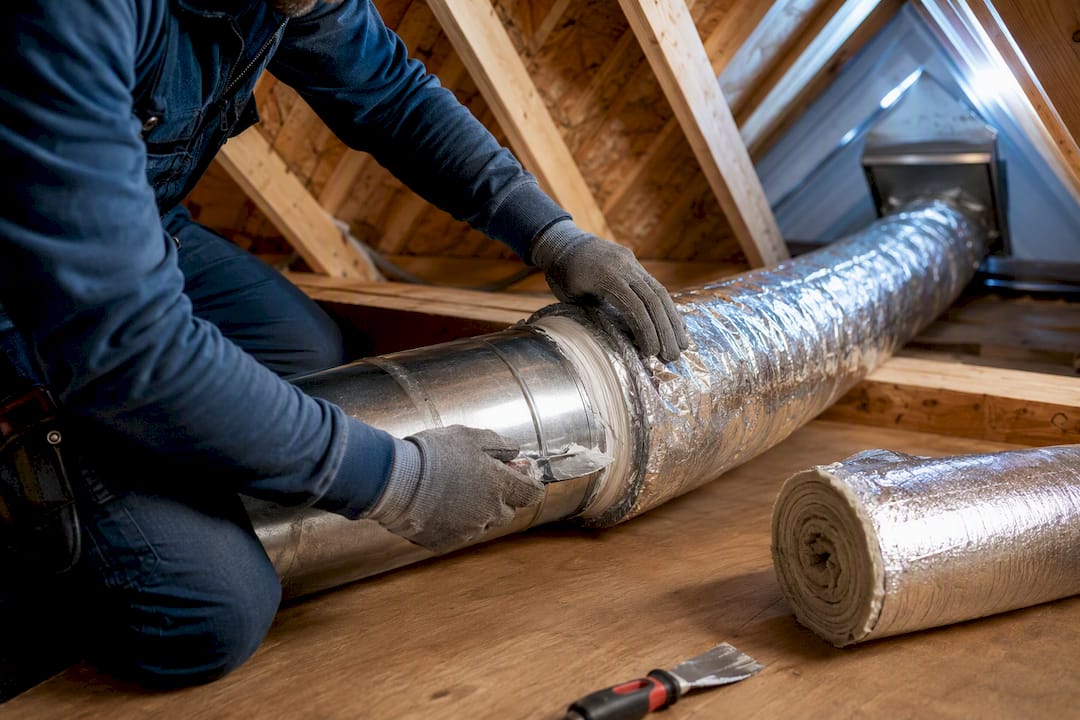
When a retrofit is needed, the usual fixes are: extending the duct run to a proper exterior cap, insulating duct sections that pass through cold attic space to prevent condensation inside the duct, sealing every joint with mastic rather than cloth tape, and testing airflow at the grille once the work is done. A local roofing contractor can also help diagnose attic moisture problems that trace back to years of improper exhaust termination.
What does it cost to install or upgrade a bathroom fan?
Costs scale with how much of the existing duct and wiring stays untouched. A straightforward like-for-like swap is the cheapest option; a full retrofit with new ducting through an exterior wall or roof is the most involved.
Condo stack tie-ins tend to land at the higher end or above it, since they often involve building approvals and shared ventilation systems that need coordination beyond a single unit. Time on site follows the same pattern: a swap is usually a same-day job, while a full retrofit with a new roof or wall penetration can take a full day or extend into a second visit if drywall patching is involved.
Watch for these cost drivers when comparing quotes: attic access difficulty, whether new wiring or a dedicated circuit is required, ceiling patching after duct rerouting, and whether a new roof penetration is needed versus reusing an existing one. Our Bowmanville renovation cost guide breaks down how these same factors affect broader bathroom project budgets.
How do I maintain a bathroom fan and know when to replace it?
A bathroom fan needs cleaning roughly twice a year. Pop off the grille, vacuum the motor housing and blades, and listen for rattling that signals a worn bearing.
Replace the fan, or call a contractor, when you notice:
- Grille airflow that feels weak even right after cleaning, suggesting the motor or duct is compromised.
- Fan noise that’s crept up over 3 sones, since that usually means bearings are failing.
- Signs the duct is venting into the attic rather than outdoors, visible as insulation staining or frost near the fan housing.
- Condensation or mould returning on the ceiling or mirror despite normal fan use.
Before assuming you need a full replacement, try the cheap fixes first: add a timer or humidistat if you’re still relying on manual switching, clean the grille thoroughly, and check that the roof or wall cap’s damper opens freely. If those steps don’t resolve it, the problem is likely in the duct run or wiring, and that’s a job for a licensed contractor.
Pro Tip: A persistently foggy mirror an hour after showering, even with the fan running, almost always points to a duct problem rather than a weak fan. Check the termination before you spend money on a new unit.
What does a licensed contractor check on-site?
A proper site visit goes well beyond swapping the fan housing. LA Rocks Renovations traces the full duct path from the grille to its exterior termination, checking the attic for improper terminations or old patch jobs left by previous owners. We measure grille airflow where possible, inspect the switch wiring for GFCI proximity issues, and verify whether an existing HRV pickup already satisfies the continuous ventilation path.
- Confirm duct material, length, and number of bends against the fan’s rated CFM.
- Check for attic penetrations, wet insulation, or signs of previous condensation damage.
- Verify the electrical circuit meets code before tying in a new fan or heat/light combo unit.
- Inspect the roof or wall cap and its backdraft damper for proper operation.
Licensed work matters because improperly wired circuits or unsealed duct joints can undo the benefit of an otherwise correctly sized fan, and permit inspections check exactly these points. The most common fix we propose after a site visit is rerouting or shortening the duct run and adding a proper cap, often the cheapest way to restore a fan’s rated performance. If you’re already planning a full renovation, our pre-demo bathroom checklist walks through what to confirm before the walls come down.
Do Bowmanville and Durham Region have specific permit rules?
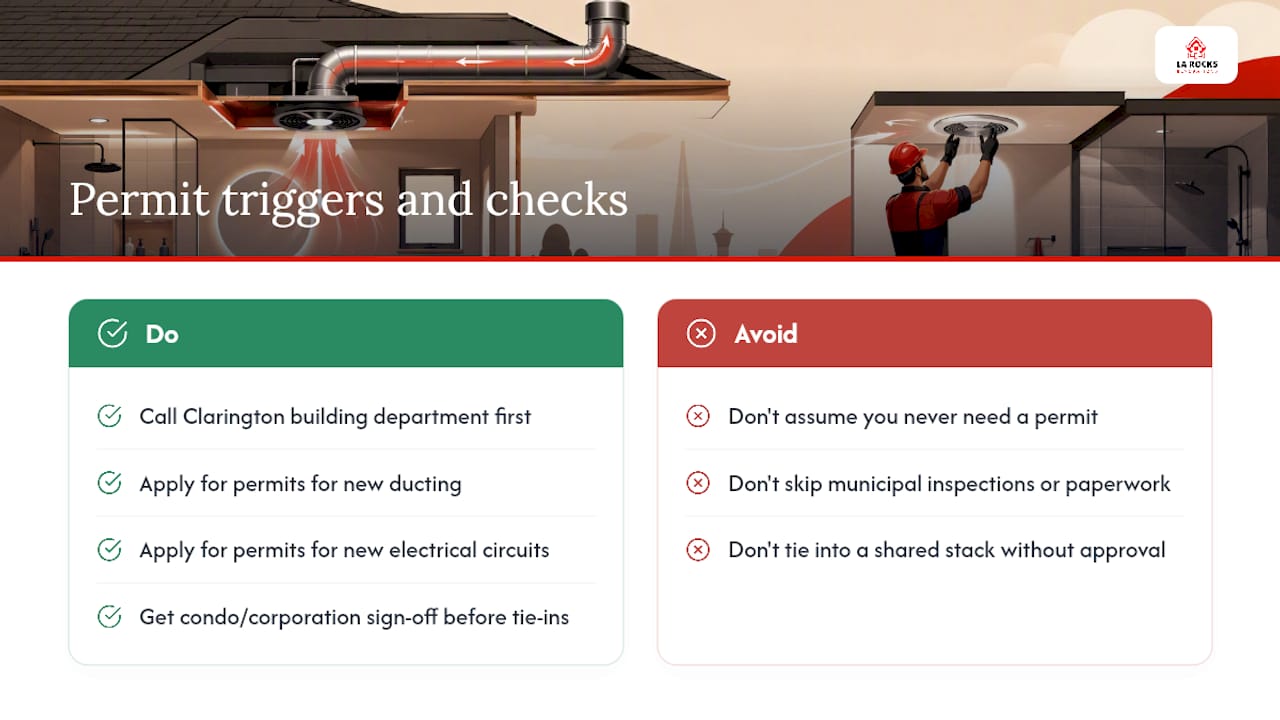
Permit requirements in Clarington and across Durham Region follow the Ontario Building Code, but enforcement and paperwork run through the municipal building department, so the specifics vary depending on your exact scope of work. A straightforward fan swap, same location and same duct path, generally doesn’t trigger a permit application anywhere in the region.
Once the project involves new ducting through an exterior wall, a new electrical circuit, or any structural opening for a roof cap, that’s typically when a permit application and inspection come into play. Homes in older Bowmanville neighbourhoods sometimes have ducts that were never properly terminated to begin with, and fixing that during a renovation counts as new work even if the fan itself isn’t changing size.
Condo and townhome owners face an extra layer. Shared stack ventilation systems usually require sign-off from the condo corporation or building management before any unit-level tie-in work happens, on top of whatever the municipality requires. Skipping that step can create disputes with a condo board even if the work itself is code-compliant.
The safest approach is a short call to the Clarington building department before booking any work that touches ducting, wiring, or a roof or wall penetration. It costs nothing, takes a few minutes, and avoids the expensive scenario of having to open up a wall a second time because a permit was missed the first time.
What fan brands hold up well in Canadian bathrooms?
Canadian winters and humid summers are hard on bathroom fans, and reliability tends to matter more than any single feature. Panasonic’s WhisperGreen and WhisperFit lines are widely used across Ontario renovations because they combine low sone ratings with built-in humidity sensing, and their motors are rated for continuous duty, which suits HRV-integrated setups well.
Broan and NuTone, both long established names in North American ventilation, make budget-friendly models that still meet OBC minimums for straightforward swaps. Delta Electronics’ BreezSignature and BreezSlim series are popular for tight ceiling cavities where duct clearance is limited, a common issue in older Bowmanville bungalows with shallow joist spaces.
Whichever brand you choose, match the fan’s actual duct outlet size to your existing duct rather than forcing a mismatch with tape and adapters. A 4 inch fan forced onto a 6 inch duct run, or the reverse, is one of the quieter ways a fan underperforms its rated CFM without anyone noticing until mould shows up months later. Our exhaust fan sizing guide covers how to match CFM ratings to your bathroom’s actual layout before you buy.
What electrical requirements apply to a new fan?
Most bathroom fan swaps reuse the existing circuit and switch location, and that’s usually fine as long as the wiring is in good condition and properly grounded. Problems show up when a homeowner adds a heat lamp, humidity sensor, or combination light unit that draws more current than the original circuit was designed for.
GFCI protection is required near bathroom water sources, and while the fan itself isn’t typically the trigger point, any nearby outlet or switch that falls within the code’s proximity rules needs it. If you’re adding a new switch, a dedicated circuit, or tying the fan into a smart humidity control system, that’s electrical work that should go through a licensed electrician or a contractor who coordinates one, not a DIY wiring job behind a finished ceiling.
Loose wire nuts, undersized wire gauge for the fan’s draw, and shared circuits overloaded by a heat/light combo unit are the three issues that show up most often during inspections. None of them are visible once the fan is mounted and the grille is back on, which is exactly why they get missed until something trips a breaker or, worse, overheats.
How does fan choice affect mould risk in Ontario’s climate?
Ontario’s humid summers and cold winters create a two-season moisture problem, and a correctly sized, correctly vented fan is one of the more effective tools against it. In summer, showers and baths dump moisture into already humid indoor air, and a weak or poorly ducted fan leaves that moisture nowhere to go but into drywall, grout, and paint.
Winter brings the opposite risk from the same root cause: warm, moist bathroom air meeting cold surfaces inside an attic if the duct terminates incorrectly. That’s when condensation forms inside the duct or attic space itself, soaking insulation and creating conditions for mould growth that can go undetected for months behind a ceiling.
CMHC’s guidance on renovations treats mechanical ventilation as a core moisture control strategy, not an optional comfort feature, and that framing holds especially true in this climate. A fan that meets the OBC minimum, vents properly outdoors, and actually gets used because it’s quiet enough to leave running does more for long-term indoor air quality than any single air purifier or dehumidifier added after the fact.
A contractor’s take on fixing ventilation early
Fixing duct routing and termination while ceilings are open costs a fraction of what it costs after drywall and tile go back up. We consistently see fewer mould call-backs and fewer finishing repairs on projects where the exhaust path got proper attention during the renovation, not patched around it. If you’re already planning bathroom work, this is the cheapest window you’ll get to do it right.
— Dylan Larocque
Get a proper ventilation assessment before you renovate
Buying the right fan online solves half the problem. The half that actually prevents mould, wet insulation, and code violations is the ductwork behind the wall, and that’s not something you can diagnose from a spec sheet. A professional contractor can trace your duct path, check the attic termination, and measure real airflow at the grille before recommending anything, so you’re not guessing at what’s hidden behind your ceiling.

Whether you need a straightforward fan swap or a full bathroom renovation that includes rerouting ductwork, a licensed team handles the electrical work, permitting questions, and ceiling patching as one coordinated job rather than three separate headaches. If your bathroom project is part of a bigger update, our basement and bathroom renovation services page covers how we scope larger jobs across Durham Region. Contact a licensed renovation contractor for a site visit and quote, and get a clear answer on what your ventilation actually needs before you spend a dollar on a new fan.
Where to confirm code and product details
Always confirm final permit requirements with your local municipal building department.
Sources
- Bathroom Exhaust Fan Ontario: CFM Sizing, Installed Cost | Get a Better Quote
- Installing or Replacing a Bathroom Exhaust Fan (ROCIS supplemental guide)
FAQ
What are the bathroom exhaust fan code requirements in Ontario?
Ontario Building Code 9.32 requires roughly 50 CFM from a switched fan, or about 20 CFM if ventilation runs continuously through an HRV, with the duct always terminating outdoors.
How do I know what kind of bathroom exhaust fan I need?
Size the fan using 1 CFM per square foot as a baseline, then choose a humidity-sensing model for a heavily used ensuite or a timer-equipped model for lower-traffic bathrooms, keeping noise at 1.5 sones or less.
What are the code requirements for bathroom exhaust fans?
Beyond the CFM minimum, the fan’s duct must terminate outdoors through a roof or wall cap fitted with a working backdraft damper, and it can never vent into an attic or soffit space.
Is 110 CFM too much for a small bathroom?
For a bathroom under 50 square feet, 110 CFM is well beyond the recommended 50 CFM baseline and will run louder and less efficiently than needed; a correctly sized fan in the 50 to 80 CFM range paired with a quiet, humidity-sensing model serves that space better.