


Bowmanville Homeowners: When Schluter's $500–$1,500 Kits Pay Off
Dylan LarocqueRequest Your Free Estimate Today
GET A FREE ESTIMATE →Yes, in most cases, especially for primary or high-use showers, curbless designs, or homes with linear drains, a Schluter shower system earns its premium. It’s less worth it for a rarely used guest shower on a tight budget. The real deciding factors are your budget, your shower design, and whether your installer has genuine Schluter training and follows manufacturer installation requirements, including flood testing. LA Rocks Renovations weighs all three before recommending it.
TL;DR:
- The success of a Schluter shower system heavily depends on the installer’s training and adherence to manufacturer installation procedures, including flood testing.
- Schluter components provide visible, correctable failure points before tiling, reducing hidden saturation risks compared to traditional mortar beds.
- The material costs range from $500 to $1,500, but faster installation and lower cure times can make it cost-effective in primary or curbless showers used frequently.
- Schluter systems perform best on level substrates and are ideal for modern designs like linear drains and lightweight heavy tile, but are sensitive to improper installation techniques.
- Verifying installer competence through certifications, project photos, flood tests, and references is crucial for system durability, regardless of the chosen waterproofing method.
Table of Contents
- What is the Schluter shower system, and how does it stop leaks?
- Where a Schluter shower system creates the most value
- Where Schluter falls short and traditional methods still make sense
- How much does a Schluter shower system cost, and is it worth the premium?
- Schluter versus traditional mortar-bed and pan liner systems
- How to verify your installer before tile goes on
- How LA Rocks Renovations decides when to recommend Schluter
- The real question isn’t Schluter versus mortar bed
- Ready to plan a Schluter-based shower renovation?
- Sources
What is the Schluter shower system, and how does it stop leaks?
Schluter didn’t invent waterproofing, but the company changed how bathroom contractors approach it. Instead of relying on a buried liner beneath a mortar bed, Schluter’s system waterproofs the surface directly beneath the tile. Water never gets the chance to soak into a hidden layer of sand and cement.
The core components work together as a system, not a collection of parts:
- Kerdi membrane: a surface-applied polyethylene sheet bonded to walls and floors with thin-set, creating a continuous waterproof layer right under the tile.
- Kerdi-Board: a lightweight foam backer board that’s already waterproof on its own, often used for shower walls, benches, and niches instead of cement board.
- Kerdi-Drain: a drain assembly with a bonding flange that the membrane adheres to directly, eliminating the traditional weep-hole drain and clamping ring.
- Kerdi-Band: a fabric strip used to seal seams, corners, and transitions where two pieces of membrane meet.
- Pre-sloped trays: foam shower bases with the slope already built in, so there’s no mortar-bed shaping required on site.
According to Schluter’s own product documentation, the membrane is fully embedded in thin-set, seams get sealed with Kerdi-Band, and the drain bonds directly to the membrane flange. That’s a fundamentally different approach from a system where the waterproofing sits buried under two inches of mortar. It also plays well with nearly any tile type, from large-format porcelain to natural stone, and it’s one of the more practical ways to build a true curbless, zero-threshold shower.
Where a Schluter shower system creates the most value
The biggest advantage isn’t really about aesthetics. It’s about what you can’t see once the tile goes on.
- Lower risk of hidden saturation. A traditional mortar bed can absorb and hold moisture for years without visible symptoms until a leak finally shows up in the ceiling below.
- Faster project timeline. Membrane systems generally need less cure time than a mortar bed, and Schluter kits can cut labour time by up to 50% compared to a fully built-up traditional assembly.
- Lighter overall assembly. Foam boards and pre-sloped trays weigh far less than a poured mortar bed, which matters on upper floors or older joist systems.
- Better fit for modern shower designs. Curbless entries, linear drains, and bench seating are easier to execute cleanly with modular Schluter components than with hand-formed mortar.
- A larger trained installer network. Contractors in trade community discussions consistently point to Schluter’s availability and training resources as a reason it’s become the default choice for many renovation crews.
Pro Tip: Ask your contractor how many Schluter installations they’ve completed in the last year, not over their whole career. Techniques and product updates change, and recent hands-on volume tells you more than a decade-old certification.
The cost premium buys you a system where the failure points are visible and correctable before tile ever goes down, rather than buried where you’ll never see them.
Where Schluter falls short and traditional methods still make sense
No system is right for every bathroom, and Schluter is no exception. The membrane approach shifts the risk from “hidden saturation” to “installer precision,” and that trade only pays off if the person installing it actually knows what they’re doing.
- Higher material cost. Kits generally run US$500 to US$1,500 for components alone, before labour, which can be hard to justify on a rarely used secondary bathroom.
- Installation is sensitive to technique. Documented failure points include incomplete thin-set embedding under the membrane, insufficient seam overlap at Kerdi-Band joints, and imperfect bonding at the drain flange, according to trade analysis of Kerdi failures.
- Uneven substrates can be a problem. If a shower floor needs significant pitch correction, a traditional mortar bed may still be the more practical solution, since Schluter performs best on a reasonably level substrate or with a pre-formed tray.
- Warranty coverage has conditions. Manufacturer warranties typically apply only when the system is installed exactly to specification, which means a shortcut taken by an untrained installer can void protection you thought you had.
A well-built traditional mortar bed, installed with a proper liner and functioning weep holes, still performs reliably. It just demands more from the installer’s craftsmanship and more curing time before you can trust it.
How much does a Schluter shower system cost, and is it worth the premium?
Cost is where most homeowners get stuck, so it helps to separate material cost from installed cost and then ask what you’re actually paying for.
Material kits for a standard shower typically land in the US$500 to US$1,500 range, depending on size and whether you add Kerdi-Board walls or a pre-sloped curbless tray. Installed cost is where the real comparison happens, since Schluter can lower total labour hours even as material cost rises. A faster install with less cure time can offset some of that material premium, particularly on a full renovation where your contractor is already on site for tile, plumbing rough-in, and finishing work. For a sense of how local labour affects the total number, see how walk-in shower costs break down in a typical renovation.
| Shower type | Where Schluter fits best | What drives the cost |
|---|---|---|
| Small guest shower, standard curb | Optional upgrade | Material premium may not be justified by usage |
| Standard primary bathroom shower | Strong fit | Balances cost against daily use and leak risk |
| Curbless or linear drain shower | Best fit | Pre-sloped trays and Kerdi-Drain simplify a design that’s hard to build traditionally |
| Heavy natural stone tile | Strong fit | Lighter substrate assembly helps manage structural load |
The premium tends to pay off fastest in a primary bathroom used daily, in humid climates, or in curbless designs where the traditional method is genuinely harder to execute well. On a guest bathroom used a handful of times a year, a traditional pan liner installed by a skilled contractor is a perfectly reasonable way to control cost without meaningfully increasing risk.
Schluter versus traditional mortar-bed and pan liner systems
The technical difference between these two approaches comes down to where the waterproofing barrier sits, and that single distinction drives almost every other trade-off homeowners need to weigh.
Schluter’s membrane bonds to the surface directly beneath the tile. A traditional system buries a PVC or CPE liner underneath a mortar bed, relying on weep holes to drain any water that gets through the tile and mortar above it. Both approaches can perform well when installed correctly, but their failure modes are genuinely different, which is why comparing them on price alone misses the point.
- Drying and moisture behaviour: a mortar bed can hold moisture for extended periods without visible signs, while a surface membrane either seals correctly or shows a detectable failure sooner.
- Weight and structural load: mortar beds are considerably heavier, which matters on older framing or second-storey bathrooms.
- Substrate tolerance: mortar beds handle uneven or sloped subfloors more forgivingly; Schluter performs best on a level substrate or with a pre-formed tray.
- Documentation your contractor should provide: photos of thin-set coverage before flooring closes it in, confirmation of weep-hole function on a traditional system, or a flood test on either system before tile installation begins.
Ask your contractor directly which system they’re proposing and why, and request to see how they handle waterproofing decisions on a project similar to yours before you sign anything.
How to verify your installer before tile goes on
The single biggest variable in whether a Schluter system succeeds isn’t the product. It’s the person installing it. Here’s what to check before your contractor covers the waterproofing layer with tile.
- Ask for Schluter-specific training or manufacturer certification, not just general tiling experience.
- Request project photos from past installs, ideally showing the membrane and drain before tile went down, not just finished shots.
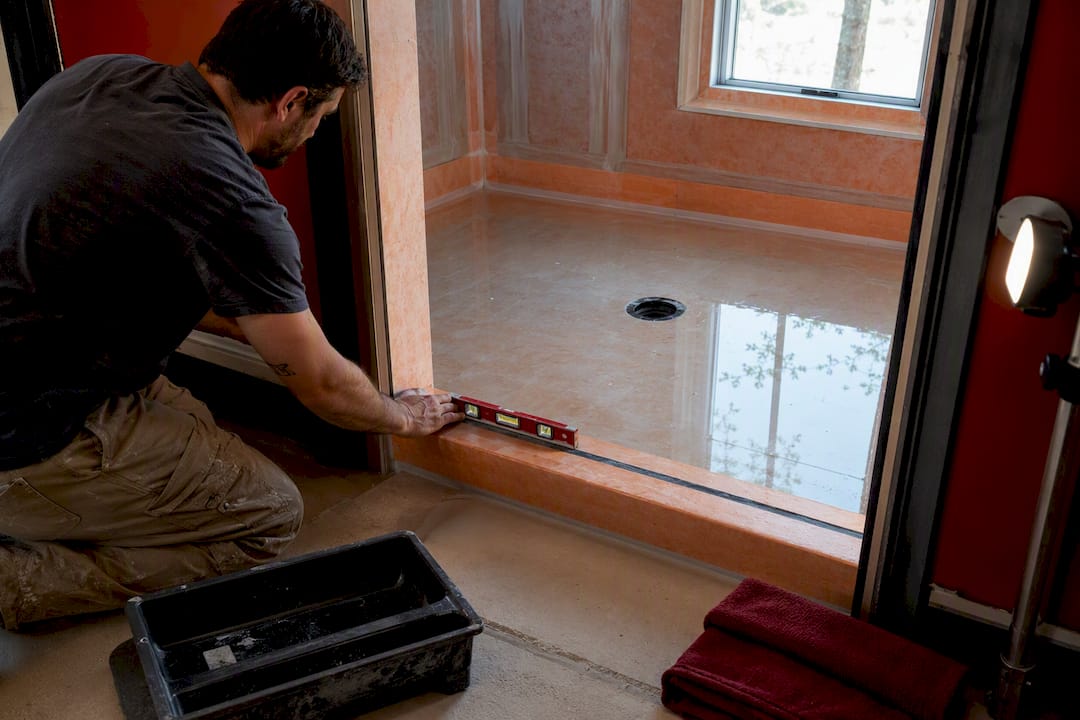
- Confirm whether flood testing will happen on your project. This involves plugging the drain, filling the shower base with water, and letting it sit for 24 hours to check for leaks before tile installation.
- Inspect Kerdi-Band overlaps for a minimum two-inch overlap at seams, and confirm the Kerdi-Drain flange is fully embedded in thin-set with no gaps.
- Ask for references from recent clients, and actually call them, since a five-year-old reference tells you little about current technique.
Pro Tip: If a contractor hesitates or gets vague when you ask for thin-set coverage photos or a flood test, treat that as a red flag. A confident, trained installer will already have this documentation ready to show you.
Refusal to document the process, no test of any kind, or references that don’t match up with the work described are the clearest signs to walk away before the drywall goes up.
How LA Rocks Renovations decides when to recommend Schluter
LA Rocks Renovations doesn’t default to Schluter on every job. The decision comes down to three things: the substrate’s structural condition, the homeowner’s finish goals (curbless entry, linear drain, heavy stone tile), and where the budget realistically sits for the whole renovation, not just the shower.
On projects where the existing subfloor needs significant slope correction, a traditional mortar bed sometimes remains the more sensible call, even with the extra labour time it demands. On curbless designs and primary bathroom rebuilds, the Kerdi system has consistently helped avoid the kind of slow, hidden leak that turns into a ceiling repair two floors down. Author Dylan Larocque has overseen bathroom renovations across Durham Region where this exact decision shaped the final outcome, and the pattern holds: the shower design and the installer’s documented technique matter more than brand loyalty to any single system.
The real question isn’t Schluter versus mortar bed
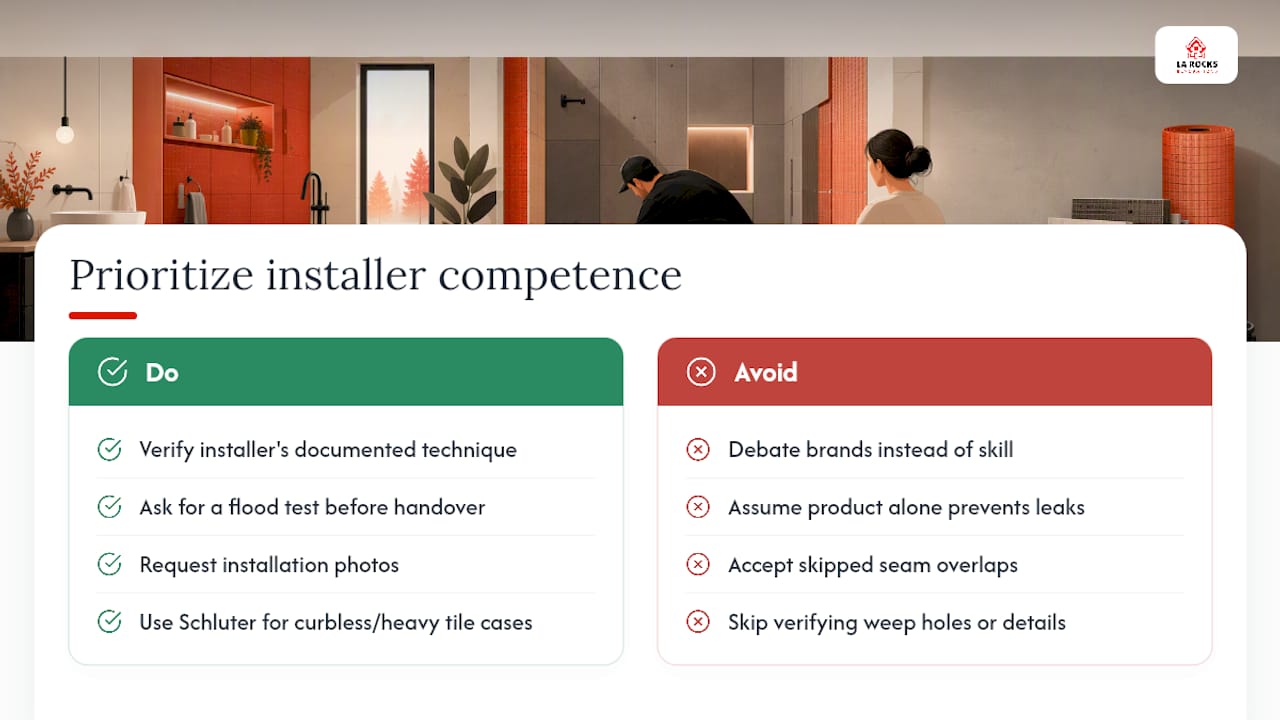
Most homeowners research this topic backwards. They ask “which product is better” when the research actually points somewhere else: installer competence is the variable that determines whether either system succeeds or fails. A poorly executed Schluter install with skipped seam overlaps will leak faster than a carefully built traditional mortar bed with proper weep holes.
That doesn’t mean the product choice is irrelevant. Schluter genuinely reduces the margin for error on curbless designs, heavy tile, and lighter-framed structures, where a traditional system asks more of the installer’s hand-shaping skill. But conventional renovation advice oversells the product and undersells the person doing the work. If you take one thing from this guide, prioritize verifying your installer’s documented technique over debating which waterproofing brand sounds more premium on a sales sheet. Ask for the flood test. Ask for the photos. That’s where the real risk lives.
— Dylan Larocque
Ready to plan a Schluter-based shower renovation?
If you’re comparing options for a curbless entry, a linear drain, or simply want a shower that won’t develop a hidden leak in year six, LA Rocks Renovations builds Schluter-based systems as a standard part of full bathroom renovations across Durham Region, from Bowmanville to Clarington and beyond.
The process starts with an in-home consultation where we assess your substrate, discuss your shower design goals, and walk through material options honestly, including when a traditional method might actually save you money without adding risk. Every waterproofing install includes documented thin-set coverage checks and, where appropriate, flood testing before tile goes on, backed by our project workmanship guarantee. If your renovation also touches flooring, framing, or finishing work beyond the shower itself, we handle that as one coordinated project rather than a string of separate trades. Get a straightforward quote and see what a properly documented Schluter installation looks like for your bathroom renovation.
Sources
- Schluter shower tile kits: are they a worthwhile investment? | CyShower
- Schluter — Shower system (product overview)
- Shower waterproofing systems: Schluter vs. traditional pan | Oakwood Remodel
- Is the Schluter Kerdi shower failure prone? | DIYTileGuy