


Heated Bathroom Floors: Are They Worth the Cost?
Request Your Free Estimate Today
GET A FREE ESTIMATE →Heated bathroom floors are worth installing if you are already re-tiling, and you use that bathroom daily, especially through a cold winter. They stop paying off when the existing floor is sound, the room sees light use, or the renovation budget is already stretched thin.
Three factors decide the answer faster than anything else:
- Are you replacing the tile anyway? Bundling heated floors into a planned re-tile keeps costs down and avoids paying twice for demo.
- Is it a daily-use bathroom? A primary or family bathroom earns back comfort value every morning; a rarely used guest bath rarely does.
- How cold does it get where you live? The colder the floor gets without heat, the bigger the comfort gap radiant heat closes.
For budgeting, most single-bathroom installs land between roughly $800 and $3,500 installed, with electric systems usually making more financial sense than hydronic for a single room. Run on a timed schedule, monthly electricity cost for most bathrooms stays in the low tens of dollars. Jump to the cost breakdown, the system comparison, or the decision checklist below for the specifics that apply to your project.
Key Takeaways
Heated bathroom floors deliver their best value when installed during a planned tile replacement in a daily-use bathroom, and their worst value as a standalone retrofit into an intact floor.
| Point | Details |
|---|---|
| Time it with a re-tile | Bundling heated floors into a planned tile replacement avoids the 50–80% retrofit premium. |
| Budget $800–$3,500 installed | Electric systems typically cost less upfront than hydronic for a single bathroom. |
| Expect $15–$25 per month | Scheduled use keeps running costs modest compared to fears of a large utility increase. |
| Demand resistance testing | Require documented pre- and post-tile readings in writing before signing any contract. |
| Match flooring to the system | Tile and stone work best; only use engineered wood or LVP when explicitly rated for radiant heat. |
| Get a local itemized quote | LA Rocks Renovations provides site visits, itemized pricing, and documented testing for Durham Region bathroom projects. |
Table of Contents
- Heated bathroom floors pros and cons: what daily comfort actually looks like
- The real downsides of radiant floor heating
- What does a heated bathroom floor cost, installed, and to run?
- Electric, hydronic, or panel systems: which one fits your bathroom?
- Planning the installation: sequence, testing, and timeline
- Should you add heated floors? A quick decision checklist
- What LA Rocks Renovations sees on real jobs
- Why timing beats every other factor in this decision
- Get a quote for your heated floor project in Durham Region
- Sources
Heated bathroom floors pros and cons: what daily comfort actually looks like
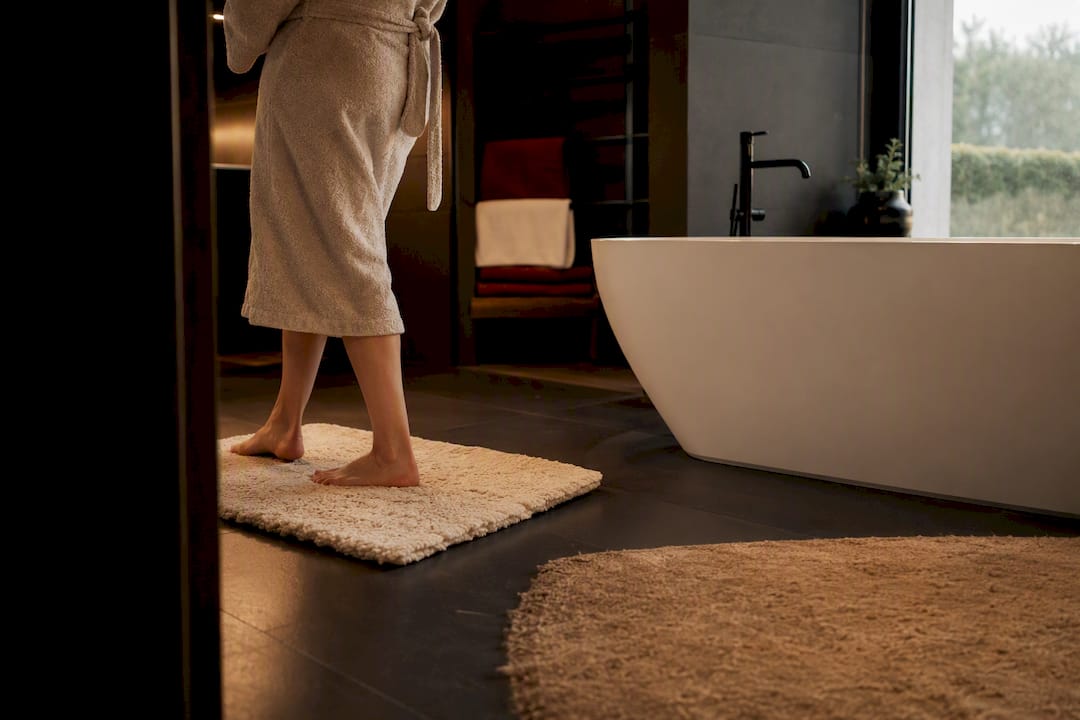
The pro side of heated bathroom floors starts with something simple: nobody enjoys stepping onto cold tile in January. That sounds minor until you live with the alternative for a winter. Warm floors remove one of the small daily frictions that homeowners consistently name as a top source of satisfaction after a bathroom remodel, and it’s a benefit you feel every single morning rather than something you have to remember to appreciate.
There’s a secondary comfort effect that surprises a lot of homeowners: a heated floor lets you keep the room’s air temperature a degree or two lower without feeling cold, because your feet are the part of your body most sensitive to surface temperature. That can offset some of the running cost of the floor heat itself.
Beyond comfort, heated floors bring a few measurable practical benefits:
- Faster surface drying. Warm tile sheds standing water faster than cold tile, which reduces the time grout lines sit wet after a shower.
- Lower mildew risk at the grout line, though heated floors are a supplement to good bathroom ventilation, not a replacement for it.
- Even, silent heat with no floor vents or forced-air noise, and the ability to zone heat to just the bathroom rather than running the whole-house furnace harder.
- A stronger first impression for guests and buyers, since radiant heat reads as a deliberate, higher-end renovation choice.
Pro Tip: If your winter routine includes a heated towel rail or a space heater plugged in near the sink, a heated floor often replaces both and does it more safely, since there is no cord and no open element near water.
On resale, real-estate professionals note that heated floors tend to positively shape a buyer’s first impression of a renovated bathroom, even though no appraisal formula credits a fixed dollar amount for the upgrade. Treat it as a comfort investment with a resale halo, not a line item that guarantees a return.
The real downsides of radiant floor heating
Heated floors have genuine drawbacks, and a straight answer to “are heated bathroom floors worth it” has to include them.
- Upfront cost is real, and retrofitting costs more than building it in. Installing a heating element under a floor that is otherwise fine forces you to demo and replace tile you didn’t need to touch, which is why retrofitting into an intact floor can run 50 to 80 percent more than adding it during a planned re-tile.
- The bathroom is out of service during the work. Demo, subfloor prep, mat or cable installation, tile setting, and curing time typically keep a small bathroom unusable for several days to a couple of weeks, longer if electrical upgrades are involved.
- Repairs are harder than fixing a cracked tile. If a heating element fails under finished tile, accessing it usually means removing tile above the fault. That’s exactly why a documented resistance test, taken before and after tile goes down, matters so much: it proves the element survived installation intact.
- Warm-up time catches people off guard. Radiant floors are not instant heat. Most systems need 20 to 40 minutes to bring tile up to a comfortable temperature, which means “on demand” heating doesn’t really work. Programming the thermostat to warm up before your usual wake time solves this, but it does require planning.
- It heats the floor, not the house. A heated bathroom floor is a comfort upgrade for one room, not a substitute for your furnace or a whole-home heating strategy.
Pro Tip: Ask any contractor bidding the job for their resistance-testing protocol in writing before you sign. A crew that can’t describe how they verify the element before and after tile is a crew you should be cautious about hiring.
What does a heated bathroom floor cost, installed, and to run?
Budgeting for heated bathroom floors means pricing two separate things: the installation and the electricity to run it. Most homeowners underestimate how much the second number matters to the decision.
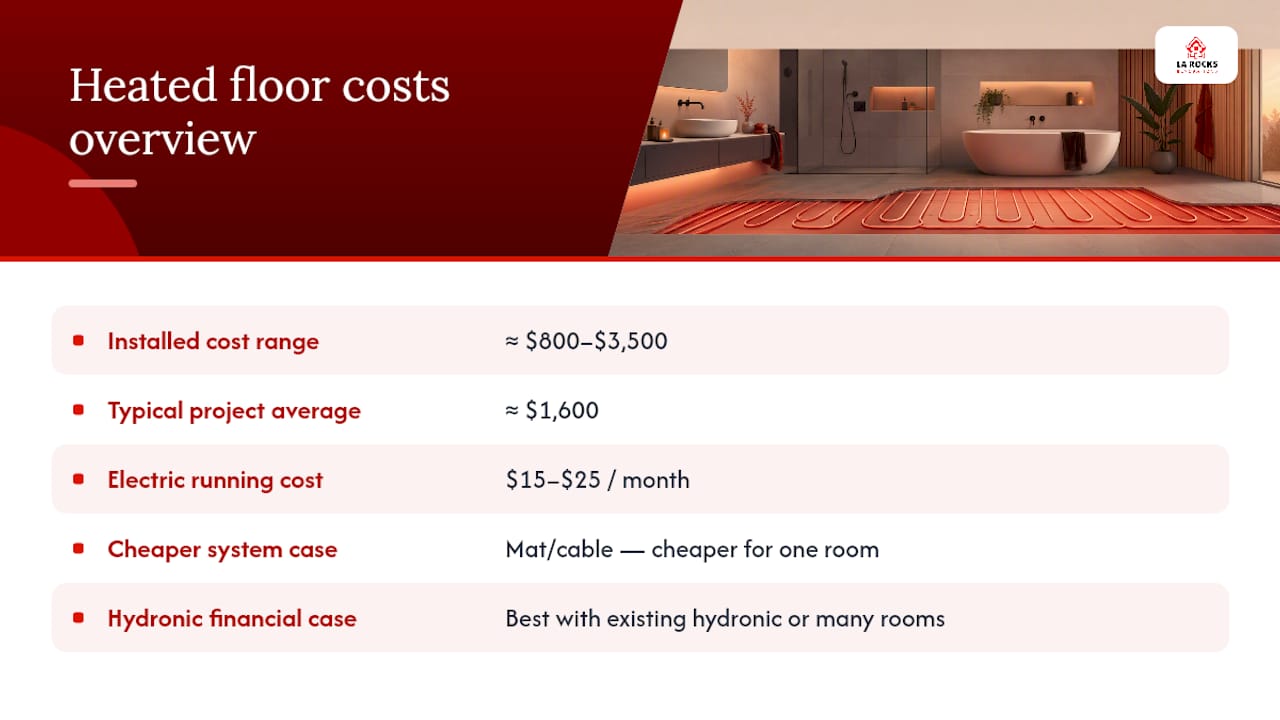
Installed costs vary by system type, bathroom size, and whether it’s new construction or a retrofit. Trade cost calculators place typical project totals between roughly $800 and $3,500, with a national average near $1,600 for a standard bathroom. Electric mat and cable systems are generally the cheaper install for a single room since they need no boiler or plumbing loop, while hydronic systems only make financial sense when a home already has hydronic infrastructure to tap into, or when heating several large rooms at once.
A retrofit adds cost on top of these ranges because you’re paying to remove and dispose of an intact floor before you can start. That’s the core reason bundling heated floors with a planned re-tile is consistently the highest-value timing for this upgrade.
Running costs are smaller than most homeowners expect. Electric radiant systems typically draw about 0.03 to 0.05 kWh per square foot per hour. Run on a sensible schedule, scheduled use in a typical small bathroom often lands around $15 to $25 per month, not the dramatic utility spike some homeowners fear. Note that regional labour rates and electricity prices shift these numbers, so treat every figure here as a planning baseline and get itemized local quotes before you commit to a budget.
Build in contingency for one thing specifically: if your electrical panel needs a new dedicated circuit or your permit process adds inspection steps, that can add a few hundred dollars you didn’t originally plan for.
Electric, hydronic, or panel systems: which one fits your bathroom?
Most single-bathroom projects come down to a choice between electric and hydronic systems, with low-profile panels as a niche third option.
Electric mat and cable systems consist of a thin heating cable, either pre-spaced into a mat or loose-laid in a serpentine pattern, installed directly under the tile and wired to a dedicated thermostat. They’re the standard choice for a single bathroom because installation is faster, there’s no plumbing involved, and the upfront cost is typically lower than hydronic for a room this size.
Hydronic systems circulate heated water through PEX tubing under the floor, tied into a boiler or water heater. They cost more to install for one room, since you’re adding a plumbing loop, but they become genuinely cost-effective when a home already runs hydronic heating or when you’re heating multiple large rooms rather than one bathroom. If you’re only doing the primary bathroom, hydronic rarely pencils out.
Low-profile electric panels are a newer option worth knowing about if your subfloor height is tight, since they add less build-up than a traditional mat under tile.
Material compatibility matters as much as system choice:
- Tile and natural stone conduct heat best and are the standard pairing for radiant systems.
- Engineered hardwood or luxury vinyl plank can work, but only when the specific product is explicitly rated for use over radiant heat by the manufacturer.
- Solid hardwood and any unrated flooring should be avoided, since manufacturers set surface-temperature limits (often around 27 to 29°C) specifically because uncontrolled heat can warp, crack, or void the warranty on materials never designed for it.
If you’re still deciding on flooring material for a heated-floor bathroom, our guide to bathroom flooring options covers how different materials perform under daily use in Durham Region homes.
Planning the installation: sequence, testing, and timeline
The single biggest lever you control on cost is timing: installing heated floors during a full tile replacement avoids paying for demo twice and keeps labour costs to the marginal cost of adding the element, not a whole second project.
- Subfloor prep comes first: the crew levels and cleans the surface so the heating element sits flat and even.
- The heating element goes down next, mat or cable, secured according to the manufacturer’s spacing requirements.
- A resistance test happens immediately after, before any tile touches the floor, to confirm the element wasn’t damaged during placement.
- The electrician ties in the dedicated circuit and thermostat, since most jurisdictions require this connection to be done by a licensed electrician.
- Tile setting and curing follow, typically the longest single phase.
- A second resistance test happens after tile is set, comparing readings to the pre-tile baseline to prove nothing was damaged during setting.
For a typical retrofit, expect one to two weeks from demo to a usable floor, longer if the electrical panel needs work. New-construction installs move faster since there’s no demo phase and no need to work around an existing finished room.
Pro Tip: Ask to see both resistance-test readings in writing, not just a verbal “it tested fine.” A number on paper, taken before and after tile, is the only real proof the element survived installation.
Watch for a few warning signs in any bid: no mention of a dedicated circuit or panel capacity, no resistance-testing commitment, a vague or undocumented warranty, or a timeline that seems too fast for the scope described; our partner’s guide on bathroom remodel mistakes to avoid covers several sequencing errors that apply directly to heated-floor projects. Our guide to common bathroom renovation mistakes covers several sequencing errors that apply directly to heated-floor projects.
Should you add heated floors? A quick decision checklist
Before requesting quotes, confirm four things about your own project:
- Are you already planning to replace the bathroom tile, or is the existing floor sound?
- Is this a daily-use bathroom, or one used occasionally by guests?
- Is the floor area open enough to make installation straightforward, or are there tight corners and fixtures that complicate coverage?
- Does your electrical panel have room for a new dedicated circuit, and does your budget account for that if needed?
When you request quotes, ask each contractor these specific questions:
- What brand and type of heating element do you install, and what’s the manufacturer’s warranty length and coverage?
- Will you provide documented resistance-test readings before and after tile installation?
- What thermostat model do you install, and does it support programmable scheduling?
- Will this job require a new dedicated electrical circuit, and is that priced separately?
- Are permits required in this jurisdiction, and is that cost included in the quote?
Install now if you’re re-tiling anyway and this is a bathroom you use every day. Skip or delay if the existing tile is in good shape, the bathroom sees light use, or the budget is already tight elsewhere in the renovation. If a full heated floor doesn’t fit the budget this round, a heated towel rail or a programmable space heater covers some of the comfort gap at a fraction of the cost, though neither matches the even, whole-floor warmth of radiant heat.
What LA Rocks Renovations sees on real jobs
LA Rocks Renovations installs flooring and manages bathroom renovations across Durham Region, and heated floor requests almost always come up at the same point in a project: right after a homeowner decides to re-tile.
A few patterns show up consistently on the jobs we run:
- The best-value calls almost always happen when heated floors are bundled into a tile replacement already on the schedule, not added as a standalone project later.
- Documented resistance testing, before and after tile, is standard practice on every heated-floor install we run, not an upsell.
- Electric systems cover the overwhelming majority of single-bathroom requests, since most Durham Region homes don’t already have hydronic infrastructure to tap into.
A heated floor installed alongside a re-tile costs a fraction of what the same system costs bolted onto a floor that’s otherwise fine. Homeowners who ask about heated floors early in the planning conversation almost always end up happier with the number on the final invoice.
[Dylan Larocque’s professional credentials or background: insert here.] [Customer testimonials or case studies specific to heated-floor installs: insert here.] [Proprietary satisfaction or performance data from completed projects: insert here.]
Why timing beats every other factor in this decision
Most articles on this topic treat heated floors as a standalone purchase decision, weighing comfort against cost as if you’re buying an appliance. That framing misses the point. The real decision is almost entirely about sequencing: whether the floor is already coming up or not.
Homeowners who ask “is heated flooring worth it” in isolation usually get a wishy-washy answer, because the honest answer depends entirely on what else is happening in the renovation. Add it during a re-tile and the marginal cost is modest against real, felt comfort. Add it as a standalone retrofit and you’re paying to demo a fine floor just to get there.
The other place conventional advice falls short is warranty and testing language. Plenty of guides mention resistance testing in passing. Very few tell homeowners to put it in the contract, in writing, with both a pre-tile and post-tile reading. That single requirement is the difference between a floor that gets fixed easily if something ever goes wrong and one where a failed element means tearing out tile you just paid to install.
If you take one thing from this guide, prioritize the timing question first and the system-type question second. Everything else is detail.
— Dylan Larocque
Get a quote for your heated floor project in Durham Region
If the numbers above line up with your renovation, the next step is getting a real, itemized quote instead of guessing from cost calculators. LA Rocks Renovations handles the parts of a heated-floor project that homeowners usually have to coordinate themselves: flooring installation, the electrical work for the dedicated circuit, tile setting, and the full bathroom renovation around it, all under one contractor instead of three separate trades you have to schedule and supervise yourself.
Booking a quote starts with a site visit, where we assess your existing floor, electrical panel capacity, and tile plans before pricing anything. You’ll get an itemized quote that breaks out the heating element, thermostat, electrical work, and tile labour separately, along with documented resistance testing built into the installation process and clear warranty terms in writing, not a verbal promise. If you’re weighing a heated floor against a broader bathroom update, our flooring installation services page covers what’s included, or you can look at bathroom tile installation costs if tile is the piece you’re still deciding on. Reach out through our contact form to schedule a site visit and get your itemized quote started.
Sources
- Heated Bathroom Floors: Cost, Types & Is It Worth Installing? (2026)
- How Much Does a Heated Bathroom Floor Cost? (2026)
- Heated Bathroom Floor Cost Calculator (2026)
- Are Heated Floors Worth It? 2 Real Estate Pros Weigh In