


Best Paint For Bathrooms: A Durham Region Guide
Request Your Free Estimate Today
GET A FREE ESTIMATE →For high-humidity bathrooms, the best paint is a moisture-resistant, mildew-inhibiting, waterborne acrylic with a satin or semi-gloss finish. Two products widely available across Canada that contractors reach for are Benjamin Moore Aura® Bath & Spa and Zinsser Perma-White. If indoor air quality is a concern, look for Greenguard Gold or low-VOC certification on the label. For Durham Region homeowners who want the job done right the first time, LA Rocks Renovations handles product selection, prep, and application as part of a complete bathroom painting service.
Quick reference for your shopping list or contractor brief:
- Waterborne acrylic or latex base (not oil-based)
- Mildewcide or antimicrobial additive in the formula
- Satin finish for most bathrooms; semi-gloss where humidity is chronic
- Mould-resistant primer (Zinsser Perma-White) when there is any mould history
- Low-VOC or Greenguard Gold certification for enclosed spaces
Table of Contents
- Why ordinary paint fails in bathrooms
- What to look for in bathroom paint
- Which finish should you choose?
- Paint products available in Canada that contractors use
- Surface prep and application steps that make paint last
- What does bathroom painting cost in Durham Region?
- DIY or hire a contractor? Questions to ask before you decide
- LA Rocks Renovations handles bathroom painting across Durham Region
- Key takeaways
- A contractor’s perspective on what actually goes wrong
- Useful sources
Why ordinary paint fails in bathrooms
Bathrooms generate more concentrated steam and condensation than any other room in a home. Standard interior paint was not formulated for that environment. When moisture penetrates the film, the paint loses adhesion and begins to peel, bubble, or blister — often within a year. Mould and mildew follow quickly, growing behind and through the paint layer where cleaning cannot reach them.
The health implications are real. Mould spores aggravate respiratory conditions and are particularly problematic in homes with children or elderly residents. Beyond health, mould remediation before a repaint adds cost and time. Proper preparation and ventilation are as important as the paint itself — a bathroom-specific formula applied over an unventilated, damp surface will still fail.
What to look for in bathroom paint
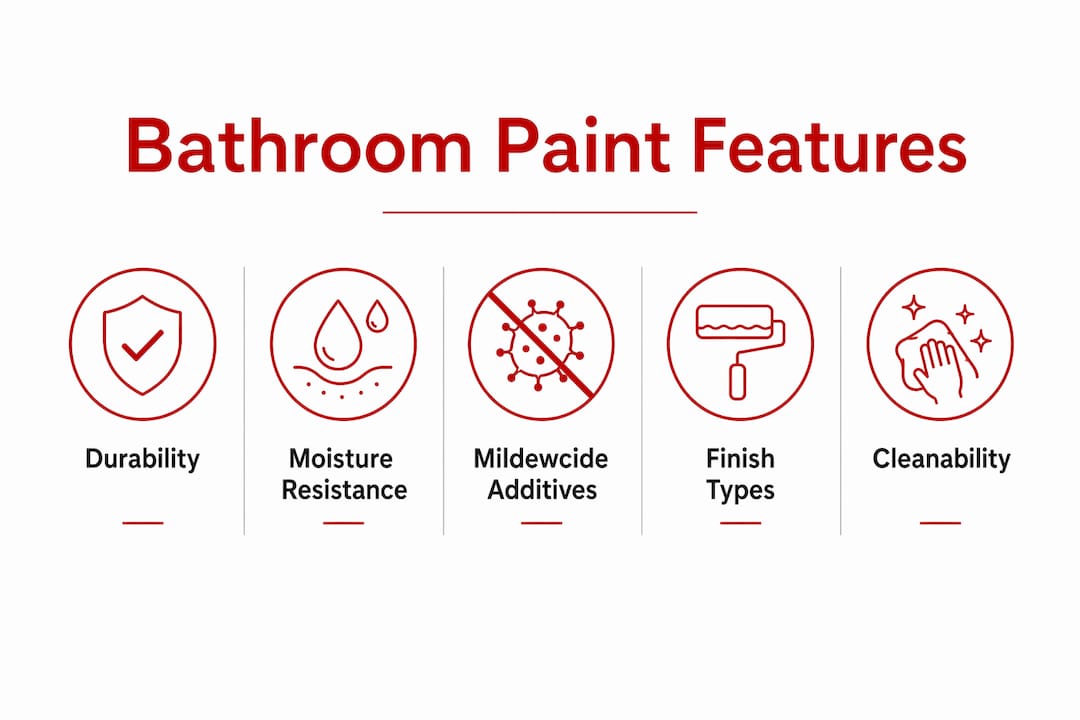
Moisture-resistant paints formulated for bathrooms share three non-negotiable chemistry features: a mildewcide or antimicrobial additive, a moisture-resistant resin, and a scrubbable sheen. When any one of those is missing, you risk mildew appearing within six months and peeling within a year.
Formulation checklist:
- Waterborne acrylic or latex base. Waterborne acrylic and latex paints dry faster, resist yellowing, and adhere better in humid conditions than oil-based alternatives.
- Mildewcide additive. Look for “antimicrobial” or “mildew-resistant” on the label — not just “washable.”
- Moisture-resistant resin. This is what keeps the film intact when steam hits the wall repeatedly.
- Low-VOC or Greenguard Gold certification. Bathrooms are small, enclosed spaces. Low-VOC formulas reduce off-gassing during and after application.
On primer: a dedicated mould-resistant primer such as Zinsser Perma-White is worth applying whenever there is a history of mould, a previously unventilated bathroom, or a surface that has been patched. Self-priming bathroom paints are acceptable on clean, well-prepped surfaces with no mould history — but they are not a substitute for proper remediation.
Which finish should you choose?
Satin and semi-gloss finishes are the standard recommendation for bathrooms because they resist moisture, wipe clean, and hold up to repeated scrubbing. The right choice depends on your bathroom’s ventilation and how much wall imperfection you want to hide.
| Finish | Best for | Moisture resistance | Cleanability | Flaw visibility |
|---|---|---|---|---|
| Satin | Well-ventilated full bathrooms | Good | Good | Low |
| Semi-gloss | Chronically humid or windowless bathrooms | Very good | Excellent | Moderate |
| Gloss | Trim, doors, and accents | Excellent | Excellent | High |
| Bathroom-engineered matte | Premium full bathrooms (e.g., Aura® Bath & Spa) | Good (formula-dependent) | Good | Very low |
The simple decision rule: if your exhaust fan is working well and the room dries within 30 minutes of a shower, satin is your finish. If the mirror stays fogged for an hour or the room has no window, go semi-gloss. Gloss belongs on trim and bathroom doors, not walls. Bathroom-engineered matte is a genuine exception — products like Benjamin Moore Aura® Bath & Spa are specifically formulated to handle humidity in a matte sheen, making them a good fit when you want a softer, more elevated look without sacrificing durability.
Paint products available in Canada that contractors use
These are practical examples, not a ranked list. A good contractor will recommend based on your specific substrate, mould history, and budget.
- Benjamin Moore Aura® Bath & Spa. A premium mildew-resistant coating with low VOC and colour stability engineered for humidity. Available in matte only — the formulation makes that finish work where standard matte would not. Covers about three to four hundred square feet per gallon with a one-hour recoat window.
- Sherwin-Williams Emerald / Duration Home. Both lines offer antimicrobial agents and moisture resistance. Duration Home is wipeable even in flat and matte sheens, which is unusual and useful for accent walls.
- Zinsser Perma-White. Primarily a primer-sealer, but it also functions as a topcoat. Its five-year mould and mildew warranty on the dried film makes it a strong choice for bathrooms with a documented mould history or limited ventilation.
- Behr Marquee / Premium Plus Kitchen & Bath. Available at The Home Depot across Canada. A solid mid-range option with mildew-resistant additives and good big-box availability for homeowners managing their own supply.
Discuss these options with your contractor before purchasing. Product availability, regional pricing, and substrate compatibility all affect the final recommendation.
Surface prep and application steps that make paint last
Getting the paint right matters less than getting the prep right. Follow these steps in order:
- Remove any existing mould. Treat affected areas with a mould-killing solution and allow to dry fully before proceeding.
- Clean and degloss. Wash walls with a TSP substitute or sugar soap to remove soap scum, grease, and residue. Scuff-sand glossy surfaces so the new coat adheres.
- Repair and sand. Fill cracks and holes with a moisture-resistant filler. Sand smooth and wipe dust clean.
- Caulk all gaps. Seal the tub-to-wall joint, around fixtures, and at trim lines with a mould-resistant silicone or latex caulk. This is where most moisture infiltration begins.
- Apply mould-resistant primer. Use Zinsser Perma-White or an equivalent when there is any mould history or bare drywall is exposed.
- Apply two coats. Allow the first coat to dry fully before recoating — check the product’s stated recoat window. Rushing this step is one of the most common causes of early failure.
- Maintain low humidity during application. Run the exhaust fan and keep the room at normal temperature. Applying paint in a cold or damp room extends dry times and can compromise adhesion.
Pro Tip: Before painting, check that your exhaust fan is actually venting to the exterior and not just into the attic or wall cavity. A fan that recirculates air inside the house does nothing to reduce humidity. A contractor should also check substrate moisture with a moisture meter before priming — painting over a damp wall is the single fastest way to guarantee early failure.
What does bathroom painting cost in Durham Region?
Paint and labour costs vary by product tier, bathroom size, and the scope of prep work required.
| Item | Budget tier | Mid-range | Premium |
|---|---|---|---|
| Labour, small bathroom | Lower end | Mid range | Higher end |
| Timeline, small bathroom | 1–2 days | 1–2 days | 2–3 days |
| Timeline, master bathroom | 2–3 days | 2–3 days | 3–4 days |
Labour pricing in Durham Region varies by contractor and scope. Factors that increase both cost and timeline include:
- Mould remediation before painting
- Ventilation upgrades (fan replacement or new ducting)
- Multiple colours or accent walls
- Trim and door painting added to the scope
- Extensive patching or skim-coating on damaged drywall
A small bathroom repaint with minimal prep can be completed in a day. A master bathroom with mould remediation and ventilation work typically runs three to four days from start to finish.
DIY or hire a contractor? Questions to ask before you decide
Most homeowners can paint a bathroom themselves if the surface is clean, the ventilation is adequate, and there is no mould history. When any of those conditions are not met, hiring a professional is the lower-risk choice.
- Is there visible mould or a history of recurring mildew? If yes, hire a contractor.
- Does the exhaust fan vent to the exterior? If not, that needs fixing before painting.
- Is the existing paint peeling or bubbling? That signals a moisture or adhesion problem that prep alone may not solve.
- Do you want a warranty on the finished work? A professional contractor can stand behind the job in a way a DIY project cannot.
- Is the bathroom a primary bath used daily? The higher the traffic and humidity load, the more a professional application is worth the investment.
When interviewing contractors, ask:
- Which paint brand and formula do you recommend for this bathroom, and why?
- What primer will you use, and will you check for substrate moisture before priming?
- How will you address the ventilation before you start?
- Do you offer a warranty on the finished work, and what does it cover?
- Can you show references or photos from previous bathroom painting jobs?
Red flags to watch for: a quote that skips primer entirely, no mention of mould inspection, vague or verbal-only warranty language, and no questions asked about the bathroom’s ventilation history.
LA Rocks Renovations handles bathroom painting across Durham Region
Choosing the right paint is only part of the job. LA Rocks Renovations brings the full picture together for homeowners in Bowmanville, Clarington, Oshawa, Whitby, Ajax, Pickering, and across Durham Region.

The team handles interior bathroom painting from product selection through to final coat, including mould remediation coordination, caulking and sealing, and ventilation assessment before a brush touches the wall. Every project starts with a clear scope and honest communication about what prep is needed, so there are no surprises mid-job. For homeowners combining a paint refresh with a larger update, LA Rocks Renovations also offers full bathroom renovations and caulking and sealing services as part of the same project.
To get an accurate quote, have your bathroom dimensions, a few photos of the current walls and ceiling, your exhaust fan details, and your preferred finish in mind. Visit larocksrenovations.com/products/painting to request a quote or get in touch with the team directly.
Key takeaways
The most durable bathroom paint combines a waterborne acrylic base, mildewcide additives, and a satin or semi-gloss finish — and no formula performs well without thorough surface prep and working ventilation.
| Point | Details |
|---|---|
| Choose the right formula | Use a waterborne acrylic with mildewcide additives and moisture-resistant resin. |
| Match finish to ventilation | Satin for well-ventilated bathrooms; semi-gloss where humidity is chronic or there is no window. |
| Never skip primer | Use a mould-resistant primer like Zinsser Perma-White whenever there is any mould history. |
| Prep determines longevity | Mould removal, deglossing, caulking, and a moisture check matter as much as the paint itself. |
| LA Rocks Renovations | Contact LA Rocks Renovations for bathroom painting quotes across Durham Region. |
A contractor’s perspective on what actually goes wrong
The most common failure pattern in bathroom painting is not the paint — it is what happens before the paint goes on. Walls that were not properly deglossed, mould that was painted over rather than treated, and exhaust fans that vent into the attic rather than outside: these are the conditions that turn a fresh coat into a peeling mess within 18 months. Durham Region homes, particularly older builds in Bowmanville and Clarington, often have bathrooms that were renovated without proper ventilation upgrades. The humidity load in those rooms is higher than the paint label assumes.
The other underestimated factor is sheen selection. Homeowners often choose flat or eggshell because it looks softer on the paint chip, then wonder why the walls are showing mildew spots by the following winter. Satin and semi-gloss exist for a reason in wet rooms. When a premium matte like Aura® Bath & Spa is specified, it is because the formulation was engineered for that environment — not because the contractor preferred the look.
Good bathroom painting is a systems job: the right product, the right prep, and the right ventilation working together. Any one of those missing and the other two cannot compensate.
Useful sources
- This Old House — trade-level guidance on finish selection and waterborne acrylic chemistry for bathrooms.
- Consumer Reports — independent testing perspective on low-VOC and Greenguard Gold certification for bathroom projects.
- SudoTool — practical breakdown of the three chemistry criteria and mildew warranty comparisons including Zinsser Perma-White.
- Benjamin Moore Aura® Bath & Spa product page — full product specs including coverage rate, recoat time, and mildew-resistance claims.
- APD Contracting — contractor-written overview of moisture-resistant paint selection for high-humidity rooms.
- LA Rocks Renovations — local contact point for bathroom painting and renovation quotes across Durham Region.